Best OASIS Assessment Tools for Home Health in 2026
Compare 2026 OASIS assessment tools for OASIS-E2: AI scribes and QA, embedded EMR scribes, predictive analytics, training, and outsourced review.
Lime Health Team
Lime Health AI

Updated October 2026: this guide now reflects OASIS-E2, in effect since April 1, 2026, and corrects how PDGM uses OASIS (the functional level comes from M1800-M1860 and M1033, the clinical group from the claim’s principal diagnosis). Medalogix is now Mosai, embedded EMR scribes are covered, vendor details were re-checked against each vendor’s site, and an analytics entry we could not re-verify was generalized.
Why OASIS Assessment Tools Matter
OASIS accuracy is the foundation of home health reimbursement, quality reporting, and compliance. Under PDGM, the functional impairment level comes from the OASIS functional items M1800-M1860 plus M1033 hospitalization risk, while the clinical group comes from the principal diagnosis on the claim. Section GG and most other items feed quality measures and Home Health Value-Based Purchasing. Inaccurate responses lead to payment errors, audit exposure, and weaker quality scores.
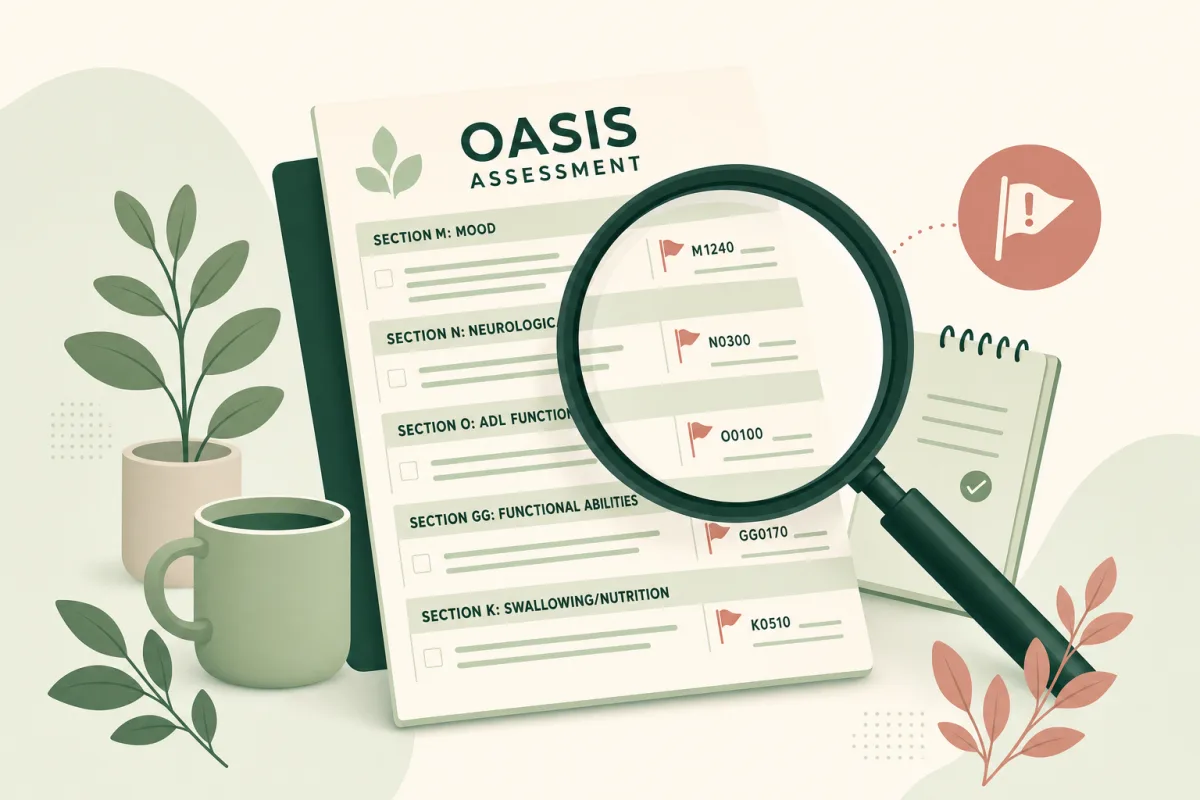
OASIS-E2 has been in effect since April 1, 2026, and it spans functional status, clinical conditions, wounds, medications, and social items such as transportation, health literacy, and social isolation. Even experienced clinicians make errors. OASIS assessment tools help agencies catch them, improve accuracy, and lower compliance risk. See the OASIS items hub for item-level coding guidance.
Here are the best options in 2026.
1. Lime Health AI, Best for AI Drafting Plus OASIS QA
Best for: Agencies wanting OASIS documentation and QA in one workflow
OASIS Scribe listens during the visit and drafts the OASIS-E2 responses, the visit note, and ICD-10 code suggestions. The clinician reviews and confirms every response. Lime’s AI OASIS review checks every M-item and GG-item for internal consistency, flags responses the clinical documentation contradicts, and shows PDGM payment impact, so your QA team corrects issues before submission.
Key strengths:
- Drafts OASIS-E2 responses from the visit conversation, and the clinician confirms each one
- Flags OASIS issues for your QA team before submission, not after billing
- Cuts documentation time by 75%, with 95% accuracy
- Sentinel QA reviews every visit note in about 10 minutes, with your QA team supervising
- Integrations with WellSky, MatrixCare, HCHB, Axxess, DSL, and Netsmart
Considerations:
- Full adoption (documentation plus QA) delivers the most value
- Focused on post-acute care settings
Pricing: Per-chart pricing. Contact Lime for details.
2. Embedded EMR Scribes, Best for Single-Vendor Simplicity
Best for: Agencies wanting AI drafting inside the EMR they already run
Home health EMRs now ship embedded AI scribes. WellSky Scribe and HCHB Curate: Scribe run inside their EMRs, so agencies on those systems try AI documentation without adding a vendor.
Key strengths:
- No separate tool or integration
- Data stays in the system of record
- One contract and one support team
Considerations:
- Scope varies, so ask which OASIS items the scribe drafts and how clinicians confirm them
- Ask whether OASIS QA and coding review are included or sold separately
- Only available on that vendor’s EMR
3. Mosai Pulse, Best Predictive Analytics for Episode Management
Best for: Agencies using predictive analytics to guide visit planning and hospitalization prevention
Mosai is the name Forcura and Medalogix adopted on October 29, 2025. Its Pulse product, formerly from Medalogix, scores risk at the visit level and sends utilization alerts so clinicians adjust care plans and visit intensity for high-risk patients.
Key strengths:
- Visit-level risk scoring for hospitalization prevention
- Utilization alerts for visit planning
- Mosai lists integrations with HCHB, MatrixCare, WellSky, and Axxess
- Referral and admissions tools from the Forcura side of the company
Considerations:
- Predictive analytics, not an OASIS accuracy or QA platform
- Does not review or validate individual OASIS responses
- Best used alongside a dedicated OASIS QA process
4. OASIS Answers, Best Educational Resource
Best for: Agencies building internal OASIS expertise and training programs
OASIS Answers, Inc. provides OASIS and HOPE education. It describes itself as a long-time CMS OASIS guidance subject matter expert, and it administers the COS-C exam, an OASIS credential.
Key strengths:
- OASIS-E2 training, webinars, and on-demand courses
- Quarterly CMS update sessions
- The COS-C certification exam
- INSTANT OASIS reference materials and private workshops
Considerations:
- Education, not software, so no automated QA
- Training alone does not catch individual assessment errors
- No integration with EMR or documentation workflows
5. Outsourced OASIS Review Services, Best for Agencies Without Internal QA Staff
Best for: Smaller agencies that lack dedicated QA reviewers
Many companies offer outsourced OASIS review, where credentialed OASIS specialists review completed assessments and return corrections and feedback. This works for agencies without an internal QA reviewer.
Key strengths:
- Expert human review
- No internal QA staff required
- Clinician feedback and education are usually included
- Flexible volume, scaled to your census
Considerations:
- Retrospective review catches errors after documentation, not during
- Turnaround of 24-72 hours is typical
- Per-chart cost adds up at scale
- Results depend on the review team
What About OASIS Analytics Platforms?
Analytics vendors benchmark OASIS-based quality measures, HHVBP performance, and star ratings against state and national averages. They show trends, not individual errors, so pair them with chart-level QA. Confirm any vendor has updated its models for OASIS-E2.
How to Choose an OASIS Assessment Tool
The right tool depends on where your OASIS accuracy problems start.
If your clinicians struggle with documentation quality (vague homebound status, missing skilled need, or clinical-OASIS disconnects), you need a tool to improve documentation at the point of care. AI tools that draft OASIS and flag issues address the root cause rather than catching errors downstream.
If your agency needs benchmarking and trend analysis, an analytics platform gives you that view.
If your challenge is clinician training on OASIS-E2 items, education builds the knowledge technology tools reinforce. Our OASIS-E2 checklist covers the changes clinicians need to know.
Most agencies benefit from a layered approach: training to build competency, technology to catch errors in real time, and analytics to monitor trends. For a category-by-category comparison, see our OASIS assessment tool guide.
OASIS Assessment Resources
- OASIS AI Review, AI-flagged OASIS issues for your QA team
- OASIS Items Hub, Item-level coding guidance for OASIS-E2
- OASIS-E2 Checklist, What changed and what to check
- What Is OASIS-E?, Guide to the OASIS-E family of assessments
- OASIS Accuracy and Compliance, How to protect your agency from audit risk