Top 10 Reasons Medicare ADRs Get Denied
The 10 most common reasons Medicare ADRs result in claim denials for home health and hospice, with specific prevention strategies for each.
Lime Health Team
Lime Health AI
ADR Denials Aren’t Random
Most agencies treat ADR denials as bad luck, auditor of the day, tough reviewer, weird interpretation. The reality is that 90% of ADR denials fall into 10 well-known patterns, and every pattern has a specific prevention strategy.
This post lists the top 10 reasons Medicare ADRs get denied (based on patterns from hundreds of MAC, RAC, and UPIC reviews) with the specific fix for each. If your agency is seeing high denial rates, run through this list to identify your top 2-3 issues, then fix those first.
For the foundational guide, see What Is an ADR? and The ADR Response Process.
1. OASIS-Narrative Inconsistency
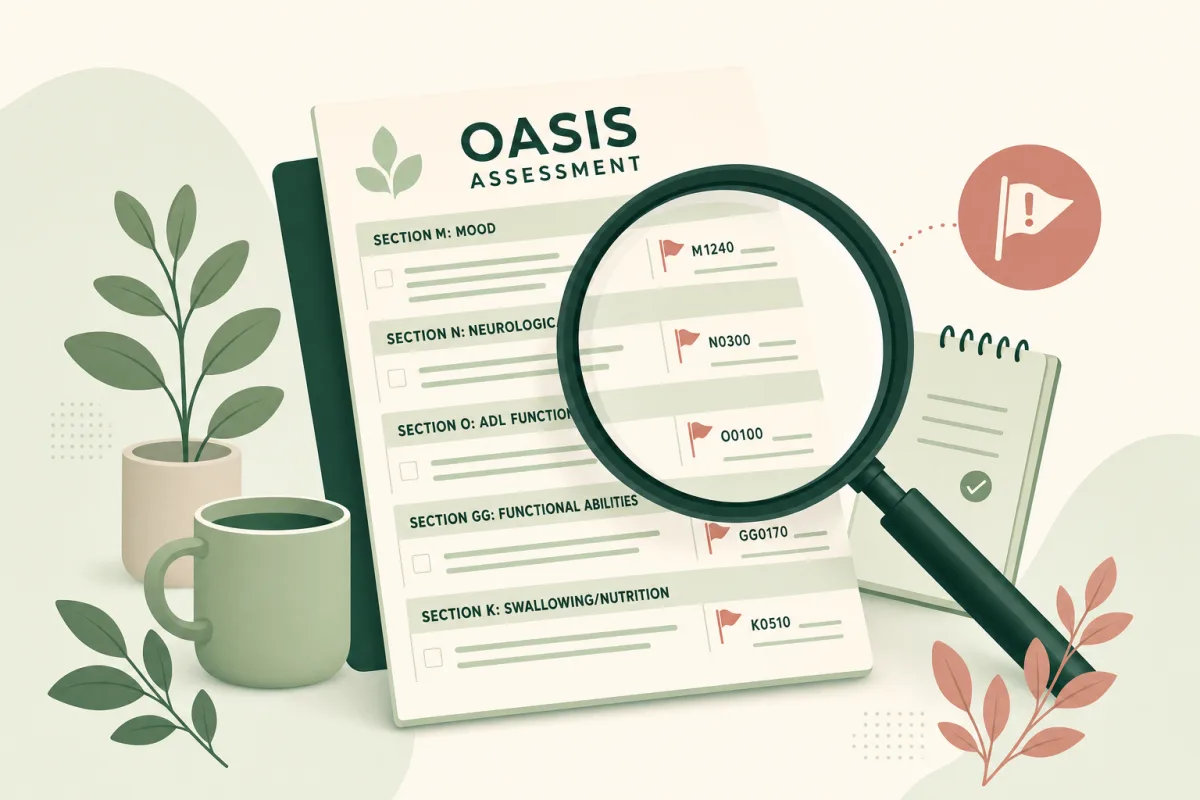
The single most common audit citation. The clinical visit narrative describes the patient one way; the OASIS responses describe the patient another way.
Common examples:
- Narrative says “patient ambulates with cane independently”; Section GG scores “requires substantial assistance”
- Narrative says “wound is healing well”; OASIS codes wound as “deteriorating”
- Narrative says “patient cognitively intact”; BIMS scores “moderately impaired”
Prevention:
- Real-time AI QA at the visit (like Lime’s OASIS Review) catches inconsistencies before submission
- QA workflow that explicitly cross-validates narrative against OASIS responses
- Clinician training on the specific items most prone to inconsistency
2. Insufficient Documentation of Homebound Status
Medicare home health requires the patient be homebound. Vague language like “patient generally stays home” or “limited mobility” is insufficient.
What auditors look for:
- Specific clinical evidence of homebound status (e.g., “patient requires assistance of two for transfers and is non-ambulatory beyond 10 feet”)
- Documentation of taxing effort to leave home
- Documentation of normal inability to leave without assistance
Prevention:
- Clinician training on homebound documentation specifics
- Documentation templates that prompt for required elements
- QA review focused specifically on homebound documentation strength
3. Insufficient Documentation of Skilled Need
Medicare requires that home health services be skilled. Generic visit notes that describe care without justifying skill are insufficient.
What auditors look for:
- Specific skilled service rationale (why an RN/PT/OT is needed vs. a non-skilled provider)
- Patient-specific complexity that requires skill
- Teaching, assessment, or management activities that require licensure
Prevention:
- Documentation templates that prompt for skilled service rationale
- Clinician training on how to articulate skill in visit notes
- QA review focused specifically on skilled need documentation
4. ICD-10 / OASIS Clinical Group Misalignment
The primary diagnosis code drives the OASIS clinical group under PDGM. If the primary diagnosis doesn’t fit the OASIS narrative, you have a mismatch.
Common examples:
- Primary diagnosis is GI bleeding; OASIS narrative is wound care focused
- Primary diagnosis is complex chronic condition; care plan focuses on a different issue
Prevention:
- Coding review that validates primary diagnosis against OASIS clinical group
- AI-assisted ICD-10 coding suggestions that align with the OASIS narrative
- Coder-clinician communication on diagnosis selection
5. Missing or Insufficient Face-to-Face Encounter
Medicare requires a face-to-face encounter with the certifying physician within specific time frames. Missing or weak F2F documentation is an automatic denial.
Required elements:
- Encounter occurred within required time window
- Encounter is documented (date, provider, content)
- Provider explicitly addresses homebound status and skilled need
- Documentation is signed by the certifying physician
Prevention:
- F2F tracking system that flags missing or expired encounters
- Coordination with referring physicians for compliant F2F documentation
- QA workflow that explicitly verifies F2F at intake
6. Plan of Care Errors
Plan of care issues (missing, incomplete, late signature, or inconsistent with visit notes) are a common denial driver.
Common issues:
- Missing physician signature
- Late signature (after visits began)
- Plan of care doesn’t match clinical assessments
- Required elements missing (frequency, duration, goals)
Prevention:
- Plan of care templates with required-element checks
- Signature tracking workflow with reminder cadence
- QA review at recertification
7. Section GG Functional Scoring Errors
Section GG functional scoring drives PDGM functional impairment level (Low / Medium / High). Errors directly impact payment and trigger ADRs when scoring patterns look unusual.
Common issues:
- Scoring not supported by narrative description
- “Activity not attempted” used incorrectly
- Inconsistent scoring across similar patients
- High functional impairment scoring without clear justification
Prevention:
- Section GG-specific clinician training
- AI scoring guidance at the visit
- Inter-rater reliability checks across clinicians
- Real-time QA flagging unusual scoring patterns
8. Missing or Weak Recertification Narratives (Hospice)
For hospice ADRs, recertification narratives are the highest-leverage document. Weak or generic narratives that don’t justify continued terminal prognosis trigger denials, especially for patients beyond the initial benefit period.
What auditors look for:
- Specific clinical evidence of decline since prior recertification
- Comparison to prior assessments
- Justification for continued hospice eligibility (six-month prognosis)
- Patient-specific narrative, not template language
Prevention:
- Recertification narrative templates with required clinical elements
- AI-assisted narrative drafting based on visit documentation
- Clinical leadership review of all recertifications, especially long-LOS patients
9. Timing Errors
Medicare has strict timing requirements for OASIS submission, F2F encounter, plan of care signing, and recertification. Late actions = automatic denial.
Common timing errors:
- OASIS submitted outside the required window
- F2F encounter outside the required window
- Plan of care signed after visits began
- Recertification narrative late
Prevention:
- Calendaring system for all time-sensitive Medicare actions
- Reminder cadence at days 5, 10, 15, 25
- Daily / weekly compliance dashboard
10. Procedural Errors in ADR Submission
Even with perfect documentation, procedural errors in submission can result in non-receipt or rejection.
Common procedural errors:
- Wrong submission channel (esMD vs NGSConnex vs paper)
- Late submission (past 30-day deadline)
- File format errors
- Missing cover letter or table of contents
- Incomplete claim identification
Prevention:
- Standard submission checklist
- Confirmation number capture for every submission
- Day-21 submission target with 9-day buffer
How to Use This List
Don’t try to fix all 10 simultaneously. Pull your last 20 ADR outcomes (paid, denied, partially paid). For each denial, identify which of the 10 categories it falls into. Then prioritize:
- Top 3 most common denial reasons at your agency get focused fixes first
- Categories with the highest dollar impact get next priority
- Categories you can fix systemically (training, templates, QA workflow) before tactical (one-off chart review)
Most agencies can dramatically reduce denial rates with focused fixes on 2-3 categories within 90 days.
The Compounding Effect of Strong Documentation
Each of these 10 fixes has a compounding effect. Better Section GG scoring → better PDGM payment AND fewer ADRs. Better F2F documentation → fewer ADRs AND lower audit risk. Better cover letters → higher first-pass approval AND less staff time per ADR.
This is why pairing structured ADR response (like Lime’s ADR Service) with upstream prevention (like Lime’s ambient AI scribe and OASIS Review) produces dramatically better outcomes than either alone.
What to Do This Week
- Pull your last 20-30 ADR outcomes
- Categorize each denial against this top-10 list
- Identify your top 3 categories
- For each, define one specific fix (training, template, QA workflow change)
- Implement and measure denial rate over the next 90 days
If your denial rate stays above 30% after focused fixes, consider outsourcing ADR response. Book a 25-minute call and we’ll walk through your specific denial patterns and what would change with Lime’s service.