Inside a TPE Review: What Auditors Actually Check
Inside a Medicare TPE review for home health: the auditor's workflow, the documentation patterns they flag, and how to pass first round.
Lime Health Team
Lime Health AI

What Auditors Actually Do (and Don’t Do)
Most home health QA teams have never seen what a Medicare auditor does inside a TPE review. They get the ADR letter, send the documentation, and wait. The actual review is a black box.
That black box is more knowable than most agencies realize. This post walks through what happens inside a TPE review, the auditor’s workflow, the specific patterns they look for, and the documentation choices that determine whether your claim is paid or denied.
For the foundational guide, see What Is an ADR?.
The TPE Auditor’s Workflow
When a TPE auditor at a Medicare Administrative Contractor (MAC) opens your ADR response, they typically follow a standardized workflow:
Step 1: Quick Completeness Check (5 minutes)
The auditor verifies the response includes the required documents:
- OASIS assessment for the time point in question
- All visit notes for the billing period
- Physician orders / Plan of Care (CMS-485)
- Face-to-Face encounter documentation
- Any other documents specifically requested in the ADR letter
If documents are missing, the auditor often denies the claim immediately without further review. Completeness is non-negotiable.
Step 2: F2F and Plan of Care Verification (10 minutes)
The auditor verifies:
- Face-to-Face encounter occurred within the required timeframe
- F2F is signed by the certifying physician
- F2F documentation explicitly addresses homebound status and skilled need
- Plan of Care is signed by the physician (timely)
- Plan of Care contains required elements (frequency, duration, goals)
These are foundational compliance items. Errors here lead to immediate denial regardless of the rest of the documentation quality.
Step 3: OASIS-Narrative Cross-Validation (20-30 minutes)
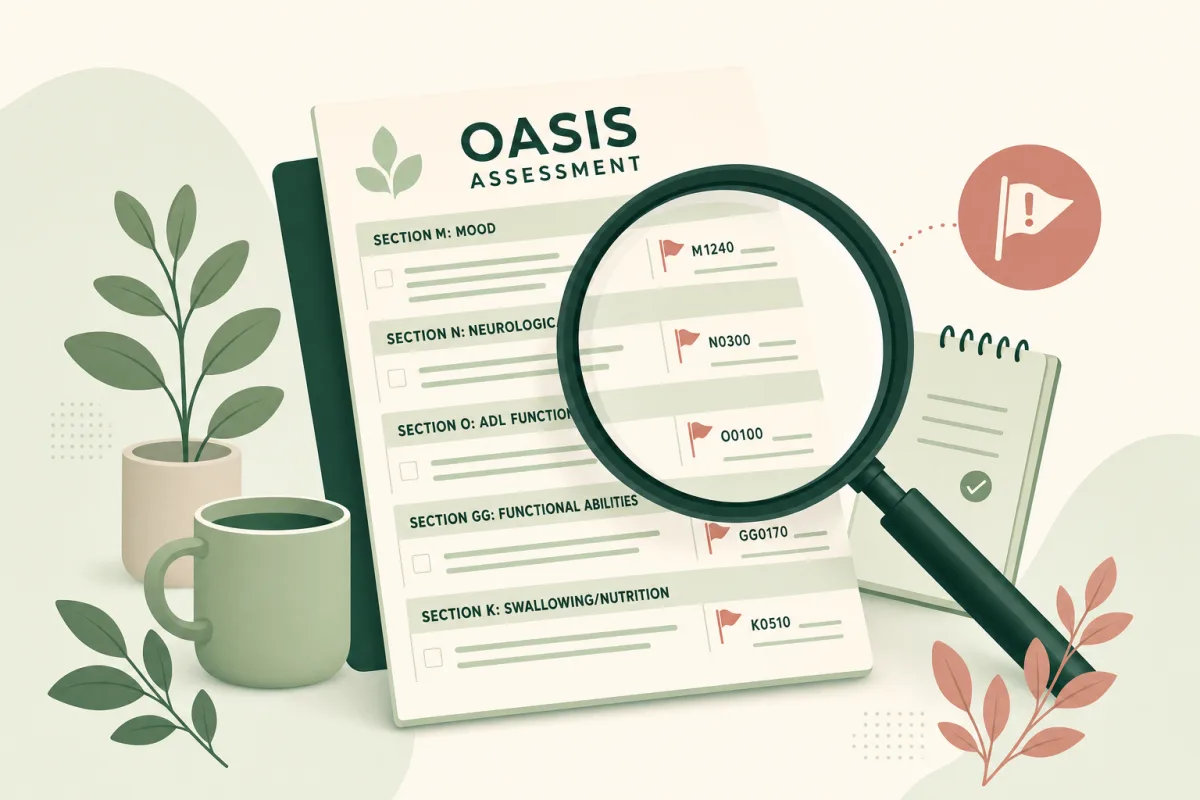
This is where most auditor time is spent. The auditor compares OASIS responses against the visit narrative for consistency. Specifically looking for:
- Section GG functional scoring, does the visit narrative describe the patient’s actual functional ability consistently with the scored level?
- Cognitive items (BIMS), does the narrative describe cognitive function consistently with the BIMS score?
- Behavioral items, narrative consistent with PHQ scoring?
- Wound documentation, wound stage and healing trajectory consistent across narrative and OASIS items?
- Service utilization items, frequency, intensity, and duration of services match what’s documented?
This cross-validation is the single highest-impact section of the review. Inconsistencies here drive 50-60% of all TPE denials.
Step 4: ICD-10 / Clinical Group Verification (5 minutes)
The auditor verifies:
- Primary diagnosis fits the OASIS clinical group
- Secondary diagnoses (drives PDGM comorbidity adjustment) are supported in clinical documentation
- Code specificity matches narrative description
Step 5: Skilled Need Justification (15 minutes)
The auditor reviews visit notes for documentation of skilled need. Specifically looking for:
- Patient-specific complexity that requires skill (not generic “skilled nursing visit”)
- Skilled service rationale (assessment, teaching, management requiring licensure)
- Documented changes in patient condition that require skilled intervention
- Skilled service consistent across visit notes (not just on selected dates)
Vague “nursing visit completed” notes are the #1 reason skilled need denials happen.
Step 6: Homebound Status (10 minutes)
The auditor reviews documentation for homebound status. Looking for:
- Specific clinical evidence (e.g., “patient requires assistance of two for transfers”)
- Documentation of taxing effort to leave home
- Documentation of normal inability to leave without assistance
- Homebound status consistent across visit notes
Generic statements like “patient generally stays home” are insufficient.
Step 7: Cover Letter Review (5 minutes)
If the response includes a strong narrative cover letter, the auditor uses it to navigate the documentation efficiently. If the cover letter is weak or absent, the auditor must search through pages of documentation looking for support, and is much more likely to miss supporting evidence and deny the claim.
This is why the cover letter is so high-leverage. It’s not just a formality; it directly affects how the auditor reads the documentation.
Step 8: Decision
Based on the review, the auditor renders one of three decisions:
- Paid, claim approved, no further action
- Partially paid, some claims approved, some denied
- Denied, formal denial issued
Total auditor time per ADR: typically 45-90 minutes for a clean response, longer for complex or messy responses.
What Auditors Don’t Do
- They don’t read every word. Auditors scan for specific patterns. Strong cover letters and document organization matter precisely because they help the auditor find the support quickly.
- They don’t give benefit of the doubt. If documentation is ambiguous, the default is denial.
- They don’t follow up for clarification. If something is missing or unclear, the claim is denied; they don’t email you for follow-up.
- They don’t review your other claims. Each ADR is reviewed in isolation. But patterns across ADRs trigger expanded review later.
The Patterns That Trigger Denial
Based on patterns across hundreds of TPE ADR reviews, the top denial drivers are:
- OASIS-narrative mismatch, described above
- Insufficient homebound documentation, vague statements vs specific evidence
- Insufficient skilled need documentation, generic visit notes
- F2F encounter issues, missing, late, unsigned, or doesn’t address homebound/skilled need
- Plan of care issues, missing signature, late signature, missing elements
- Section GG scoring not supported by narrative
- BIMS or PHQ scored without documented administration
- ICD-10 / clinical group mismatch
- Late submission (procedural denial)
- Wrong submission channel (procedural denial)
For the full denial-prevention playbook, see Top 10 Reasons Medicare ADRs Get Denied.
What This Means for Your ADR Response Strategy
Knowing the auditor’s workflow tells you where to invest:
Highest ROI: OASIS-Narrative Consistency
50-60% of denials trace to this. Real-time AI QA catches inconsistencies at the visit, not after. Lime’s OASIS Review runs hundreds of consistency rules automatically.
High ROI: Strong Cover Letter
The cover letter determines how efficiently the auditor finds support. Strong cover letter = higher first-pass approval. Many in-house ADR responses skip or under-invest in the cover letter.
High ROI: F2F and Plan of Care Compliance
Procedural items are binary, they’re either correct or denied. Tracking systems and signature workflows prevent these denials.
Medium ROI: Skilled Need and Homebound Documentation
Requires clinician training and documentation templates. Not a quick fix, but compounding.
Medium ROI: Section GG Training
Especially important post-OASIS-E2 transition. Section GG scoring drives both PDGM payment and a major share of audit findings. See OASIS-E2 Training.
The Auditor’s Perspective Helps You Win
ADR response often feels adversarial, agency vs auditor. But understanding the auditor’s workflow reveals that they’re not trying to deny claims; they’re trying to verify compliance under time pressure. Your job is to make their verification easy.
A well-organized ADR response with a strong cover letter, complete documentation, clear OASIS-narrative consistency, and explicit homebound/skilled-need documentation gets approved efficiently. A messy response with weak documentation gets denied, not maliciously, but because the auditor can’t find the support they need to approve.
How AI Changes the Math
Manual ADR response can’t easily check 100% of OASIS-narrative consistency, can’t always produce strong cover letters consistently, and can’t track every procedural item. AI-assisted ADR response can do all three reliably:
- Lime’s ambient AI scribe prevents most consistency issues at the visit
- Real-time OASIS QA flags issues before they reach the EMR
- Lime’s ADR Response Service handles the entire response with consistent quality across every ADR
The result: 90%+ first-pass approval rates vs industry average of 50-70% for manual response.
What to Do This Week
- Pull your last 10 ADR responses and review them as if you were the auditor, does the cover letter help you find the support?
- Audit your last 20 denials, categorize by the patterns above
- Pick one or two highest-impact areas to fix (usually OASIS-narrative consistency or cover letter quality)
- If your QA team is over capacity, consider outsourcing ADR response to free them up for upstream prevention work
The black box of TPE review is more knowable than most agencies realize. Use that knowledge.