The OASIS-E2 AI Scribe Built for Home Health
Lime Health AI is the leading ambient scribe purpose-built for OASIS-E2. Cut OASIS-E2 documentation time from 30+ minutes to under 10, without changing how clinicians visit patients. Real-time QA, PDGM-aware scoring, and direct EMR sync.
Pilot-friendly Try Lime for free
Key Takeaways
- →Lime is the leading ambient AI scribe purpose-built for OASIS-E2, not adapted from a physician-office tool.
- →Cuts OASIS-E2 documentation time from 30+ to under 10 minutes per visit; saves 2-3 hours per clinician per day.
- →PDGM-aware scoring built in, flags M1800-M1860 and M1033 responses likely to misclassify functional impairment before submission.
- →Direct EMR sync with HCHB, WellSky, MatrixCare, Axxess, DSL, no double entry.
- →HIPAA compliant with signed BAA; 5.0★ rating on G2; 30,000+ charts processed annually.
From the field to the EHR in three steps.
Ambient AI captures the visit. Real-time coaching flags missed OASIS items while you're still with the patient. The finished note syncs to your EMR.
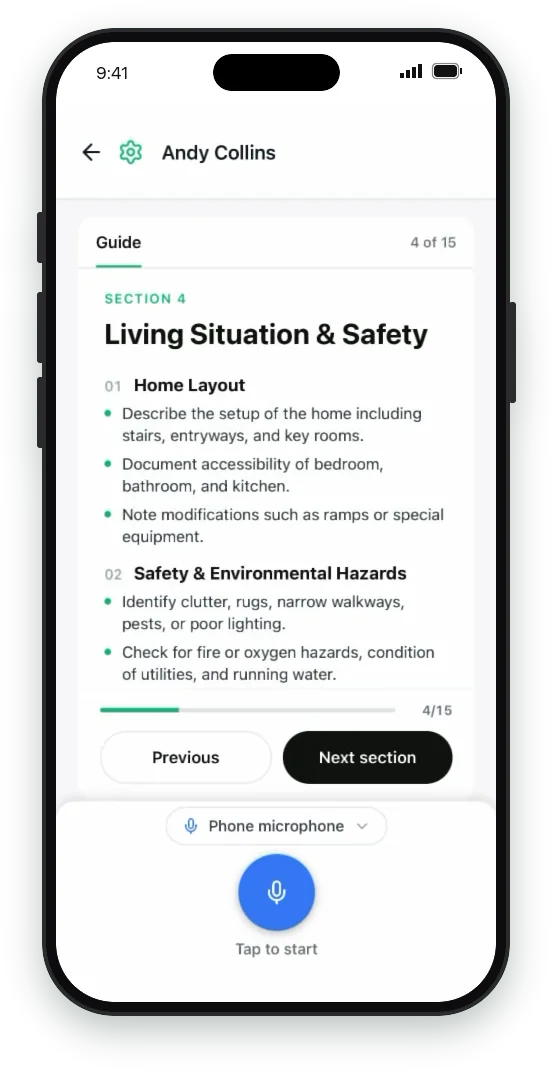
Open the app, start the visit
Clinician taps record in OASIS Scribe. The AI listens during the natural patient encounter, no typing, no dictation, no workflow changes.
In-field OASIS coaching
Lime flags missed OASIS sections, weak narratives, and documentation gaps via real-time AI QA while you're still with the patient, fix the assessment on the spot.
Pilot-friendly Try Lime for free
From an OASIS reviewer using Lime
Fast charting in home health, OASIS, coding, and visit notes. Able to identify what you missed.
OASIS-E2 documentation per visit (down from 30–45 min)
Saved per clinician per day
Rating on G2 · 30,000+ charts/year
Why OASIS-E2 Needs a Purpose-Built Scribe
Most ambient AI scribes were built for physician office visits, short encounters with structured E/M coding. OASIS-E2 is fundamentally different. A home health Start of Care assessment per the CMS OASIS-E2 Guidance Manual can run 60+ minutes, captures 100+ structured data points across functional, cognitive, and SDOH domains, and the responses directly drive PDGM payment classification.
A generic ambient scribe will give you a transcript and a SOAP note. An OASIS-E2 scribe gives you a fully drafted OASIS-E2 assessment, with PDGM-aware scoring, real-time QA, and direct EMR sync. That's what Lime is.
What OASIS Scribe Does for OASIS-E2
- Drafts OASIS-E2 M-items from the natural visit conversation, no dictation, no extra clinician steps.
- Drafts M1800-M1860 and Section GG responses, with PDGM-aware logic that flags M1800-M1860 and M1033 responses likely to misclassify functional impairment.
- Captures cognitive and behavioral items (BIMS, PHQ-2/9) by recognizing screening administration during the visit.
- Captures standardized social items such as A1255 Transportation and B1300 Health Literacy, flagging missing responses and prompting follow-up.
- Suggests ICD-10 codes ranked by PDGM clinical group impact and comorbidity adjustment relevance.
- Flags real-time inconsistencies, between OASIS responses and visit narrative, between OASIS items, and against PDGM scoring logic.
- Syncs approved data to your EMR, HCHB, WellSky, MatrixCare, Axxess, DSL.
Ambient Capture, Built for Home Health Visits
The clinician opens the Lime app on phone or tablet, hits record at the start of the visit, and conducts the assessment naturally. The AI handles transcription, OASIS-E2 item extraction, ICD-10 suggestion, and QA review in the background. By the time the clinician closes their bag, the documentation is ready for review, usually in less than 5 minutes.
Recording is always initiated by an affirmative action. The app never listens passively. Patient consent is obtained before every recorded encounter.
Real-Time PDGM Optimization
The PDGM functional impairment level comes from points on M1800-M1860 and M1033. A one-step error, such as coding M1860 Ambulation as a 1 when the patient needs a walker, can shift the functional level for the 30-day period. Section GG earns no PDGM points but feeds quality measures and HHVBP.
OASIS Scribe evaluates M1800-M1860 and GG scoring against the patient's described functional status during the visit. When the AI detects a likely under-scoring (or over-scoring), it flags the item for clinician review with the supporting evidence from the conversation. Clinicians make the final call.
EMR Integration: No Double Entry
Lime integrates natively with the EMRs home health agencies actually use:
OASIS Scribe vs Traditional QA-Only Workflow
| Workflow Step | Traditional Approach | With OASIS Scribe |
|---|---|---|
| SOC OASIS documentation | 30–45 min after visit | Under 10 min during visit |
| QA review | Days later, sample-based | Real-time, 100% of charts |
| PDGM scoring | Manual; errors common | PDGM-aware; flagged in real time |
| EMR data entry | Manual double entry | Direct sync, no double entry |
| After-hours charting | 2–3 hrs/clinician/day | Eliminated |
OASIS Scribe for OASIS-E2, FAQ
What is an OASIS-E2 AI scribe?
Does OASIS Scribe support OASIS-E2?
How much time does an OASIS-E2 scribe save?
Does the OASIS-E2 scribe replace QA review?
Is the OASIS-E2 scribe HIPAA compliant?
How does the scribe handle PDGM scoring?
See OASIS Scribe in action.
Request a Demo