Patient Intake Automation That Turns Referrals Into Admissions in Hours
Lime's intake automation parses referral PDFs and faxes, verifies payer eligibility in real time, and generates draft admission notes, eliminating 30–60 minutes of manual data entry per referral.
Pilot-friendly Try Lime for free
Trusted by intake coordinators and admissions teams. Cut admissions cycle time from days to hours while reducing denial rates from missed eligibility issues.
What Is Patient Intake Automation?
Patient intake automation is software turning a home health or hospice referral into a ready-to-admit patient with minimal manual work. Lime’s intake automation parses referral PDFs and faxes, verifies payer eligibility in real time, flags admission red flags, and drafts the admission note. Per-referral processing drops from 30–60 minutes of manual data entry to under 10 minutes of review.
New from Lime
Lime Intake: the referral watched, read, and answered automatically
Intake automation now runs end to end. Lime Intake monitors your referral portals, fax line, and email inbox in one queue, reads every packet, screens it against your service line, geography, payer, and clinical fit criteria, and returns an accept or decline in minutes. Accepted patients are created in your EMR. Referrals needing a phone call route to your team.
Built for agencies where intake automation is the bottleneck.
- →Your intake team spends 30-60 minutes reviewing each referral packet
- →You're still manually pulling data from PDFs, faxes, and scanned packets
- →Eligibility and authorization issues are being caught too late
- →Start-of-care scheduling is delayed because admission info is incomplete
- →Your best intake coordinator has become the "human routing engine"
- →You want faster admissions without hiring more back-office staff
Features
Key Features
AI Referral Document Parsing
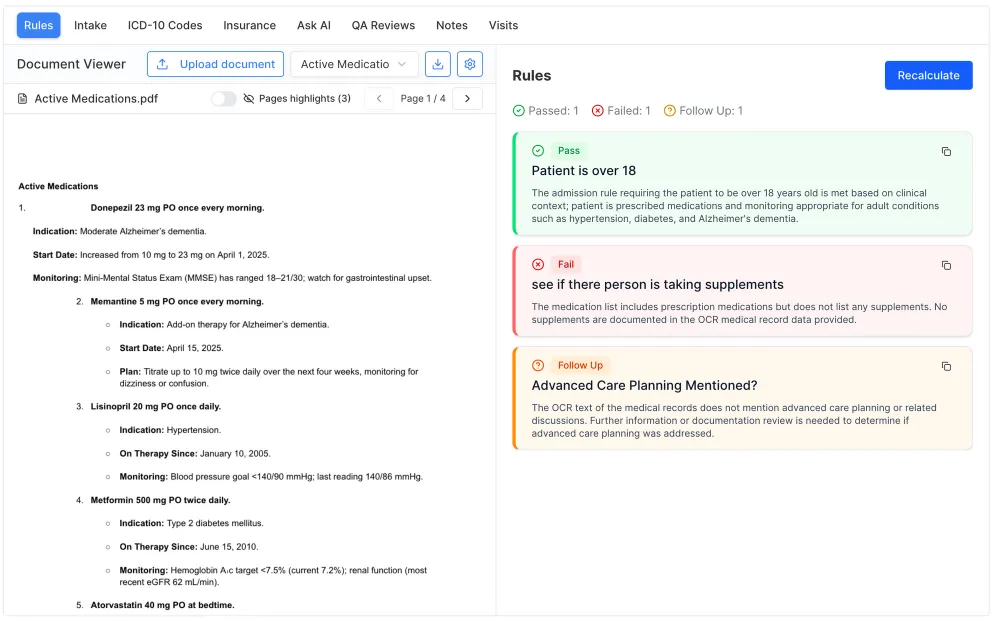
Extract patient demographics, diagnoses, insurance, and physician orders from PDFs, faxes, and scanned referral packets, automatically.
Real-Time Eligibility Verification
Direct payer API and clearinghouse integration confirms coverage and authorization requirements at the point of referral, not after admission.
Rule-Based Intake Screening
Configurable rules catch admission red flags (non-covered services, missing authorizations, out-of-network providers) before they become claim denials.
AI Draft Admission Notes
Generate compliant admission summaries and start-of-care drafts directly from the referral packet, ready for clinician review and edit.
Stop letting intake slow down admissions.
Current intake workflow
With Lime
From the field to the EHR in three steps.
Ambient AI captures the visit. Real-time coaching flags missed OASIS items while you're still with the patient. The finished note syncs to your EMR.
Open the app, start the visit
Clinician taps record in OASIS Scribe. The AI listens during the natural patient encounter, no typing, no dictation, no workflow changes.
In-field OASIS coaching
Lime flags missed OASIS sections, weak narratives, and documentation gaps via real-time AI QA while you're still with the patient, fix the assessment on the spot.
Pilot-friendly Try Lime for free
Cut Admissions Time 80%
Reduce per-referral processing from 30–60 minutes of manual data entry to under 10 minutes of AI-assisted review.
Fewer Denials at the Front
Real-time eligibility and authorization checks catch issues upfront, protecting downstream PDGM revenue from front-of-episode errors.
Faster Time to First Visit
Compress admission cycle time from days to hours, improving referral source relationships and patient experience.
Built for human-reviewed healthcare workflows.
Lime doesn't auto-admit patients. The AI drafts. Your team approves. Every output is reviewable, editable, and configurable to your agency's rules.
HIPAA-compliant workflows
Encrypted in transit and at rest. Signed BAA with every agency.
AI drafts, your team approves
Every admission note is reviewed by a coordinator before submission.
Configurable agency rules
Intake screening tuned to your payer mix, scope, and risk tolerance.
Works with your EMR
Bidirectional sync to HCHB, WellSky, MatrixCare, Axxess, DSL, Netsmart.
Need People, Not Just Software?
Add a trained intake coordinator to your team, without the hiring.
Lime pairs intake automation with trained virtual intake support, giving your agency extra intake capacity without hiring, training, or managing another full-time coordinator. Software is often included at no additional cost.
What Is Healthcare Intake Automation?
Healthcare intake automation is the use of software (increasingly AI-powered) to handle the tasks involved in admitting a new patient: parsing referral documents, verifying insurance eligibility, checking authorization requirements, generating draft admission notes, and routing the case to the right clinical team. For home health and hospice agencies, intake automation can reduce admission cycle time from days to hours and dramatically lower denial rates from missed eligibility issues.
Patient Intake Automation: The Key Components
Modern patient intake automation software combines several capabilities that historically required manual coordinator effort:
- Referral document parsing. AI extracts patient demographics, diagnoses, insurance, and orders from PDFs, faxes, and scanned documents.
- Real-time payer eligibility verification. Direct payer API or clearinghouse integration confirms coverage and authorization requirements at the point of referral.
- Rule-based intake screening. Configurable rules catch admission red flags before they become claim denials.
- AI-generated admission summaries. Draft admission notes built from the referral packet and verified eligibility data.
- Workflow routing. Automated task assignment to intake coordinators, nurses, and schedulers based on case characteristics.
Referral Intake Automation: The Front of the Funnel
Referral intake automation targets the most time-intensive part of the admissions process: receiving referrals from hospitals, physician offices, and discharge planners; parsing the referral packet (often a PDF or fax); extracting required clinical and insurance data; and routing to the intake coordinator queue.
Without automation, intake coordinators spend 30-60 minutes per referral on manual data entry, eligibility verification calls, and document organization. With AI-powered referral intake automation, that drops to under 10 minutes per referral, and the data is more accurate because the AI extraction is consistent.
Intelligent Intake: What "AI-Powered" Actually Means
"Intelligent intake" goes beyond simple form automation. An intelligent intake platform:
- Reads any referral format, structured (HL7, FHIR) or unstructured (PDF, fax, image)
- Extracts and validates clinical data without requiring manual mapping
- Cross-references insurance eligibility in real time
- Identifies authorization gaps before the patient is admitted
- Generates a draft admission note that the intake nurse reviews and edits, rather than starts from scratch
- Routes complex or high-risk cases to appropriate reviewers automatically
Why Intake Automation Matters for PDGM
Under the Patient-Driven Groupings Model (PDGM), the primary diagnosis code captured at admission directly drives 30-day payment classification. An intake error at the front of the episode, wrong primary diagnosis, missing comorbidities, incorrect functional impairment scoring, costs hundreds of dollars per period and is hard to recover after submission.
AI-powered intake automation that cross-references the referral packet, verifies clinical data, and pre-populates the OASIS Start of Care assessment dramatically reduces these front-of-episode errors. OASIS-E2 compliance starts with the SOC assessment, and that starts with intake.
Intake Automation Across Care Settings
Lime's admissions intake automation is built for multiple post-acute settings:
- Home health: Referral parsing, payer eligibility, OASIS-aligned admission notes
- Hospice: Referral processing, hospice eligibility verification (terminal prognosis documentation), election form support
AI Works Best With a Trained Coordinator
Intake automation software is powerful, but the agencies getting the most out of it pair the AI with a dedicated team member who runs it day-to-day. The AI handles document parsing, eligibility verification, and draft note generation. The coordinator triages, validates, escalates complex cases, and communicates with referral sources. The bundle delivers faster time-to-admission, fewer missed referrals, and lower cost than running either alone.
Get the AI and a trained intake coordinator in one engagement: Virtual Intake Staff. Software is often included at no additional cost.
Related Resources
FAQ
Intake Automation FAQ
Common questions about AI-powered intake automation for home health and hospice.
Intake automation in healthcare is the use of software (increasingly AI-powered) to handle the tasks involved in admitting a new patient: parsing referral documents, verifying insurance eligibility, checking authorization requirements, generating draft admission notes, and routing the case to the right clinical team. For home health and hospice, intake automation can reduce admission cycle time from days to hours and dramatically lower denial rates.
Patient intake automation software is a tool that streamlines the steps required to take a referral from initial receipt to a fully admitted patient. Modern intake automation includes AI-powered referral document parsing (extracting patient demographics, diagnoses, insurance, and orders from PDFs and faxes), real-time payer eligibility verification, rule-based workflow routing, and AI-generated draft admission notes. Lime Health AI's admissions intake module is purpose-built for home health and hospice agencies.
Referral intake automation specifically targets the front of the admissions funnel: receiving referrals from hospitals, physician offices, and discharge planners; parsing the referral packet (often a PDF or fax); extracting required clinical data; verifying eligibility; and routing to the intake coordinator queue. Without automation, intake coordinators spend 30-60 minutes per referral on data entry. With AI-powered referral intake automation, that drops to under 10 minutes.
AI handles healthcare intake by combining several capabilities: (1) document understanding, extracting structured data from unstructured PDFs, faxes, and scanned documents; (2) payer eligibility lookup via direct payer API integration or clearinghouse connections; (3) rule-based screening to identify intake red flags before they become denials; (4) draft documentation generation including admission summaries and care plan starts; and (5) workflow routing to assign tasks to the right team members. Lime Health AI delivers all of these as a single platform.
Manual admissions intake for a home health or hospice patient typically takes 1-3 days from referral receipt to admission. The process involves: 30-60 minutes of intake coordinator data entry per referral, separate eligibility verification calls or portal checks, manual document organization, intake nurse review and admission visit scheduling, and back-and-forth with the referring provider for missing information. AI-powered intake automation can compress this to hours, not days, with significantly lower error rates.
Cut admissions intake time from days to hours.
Request a Demo