AI Clinical Notes, Automated Documentation That Writes Itself
Lime Health's AI clinical notes platform listens during patient encounters and generates comprehensive, compliant clinical documentation, saving clinicians hours every day and eliminating after-hours charting.
Pilot-friendly Try Lime for free
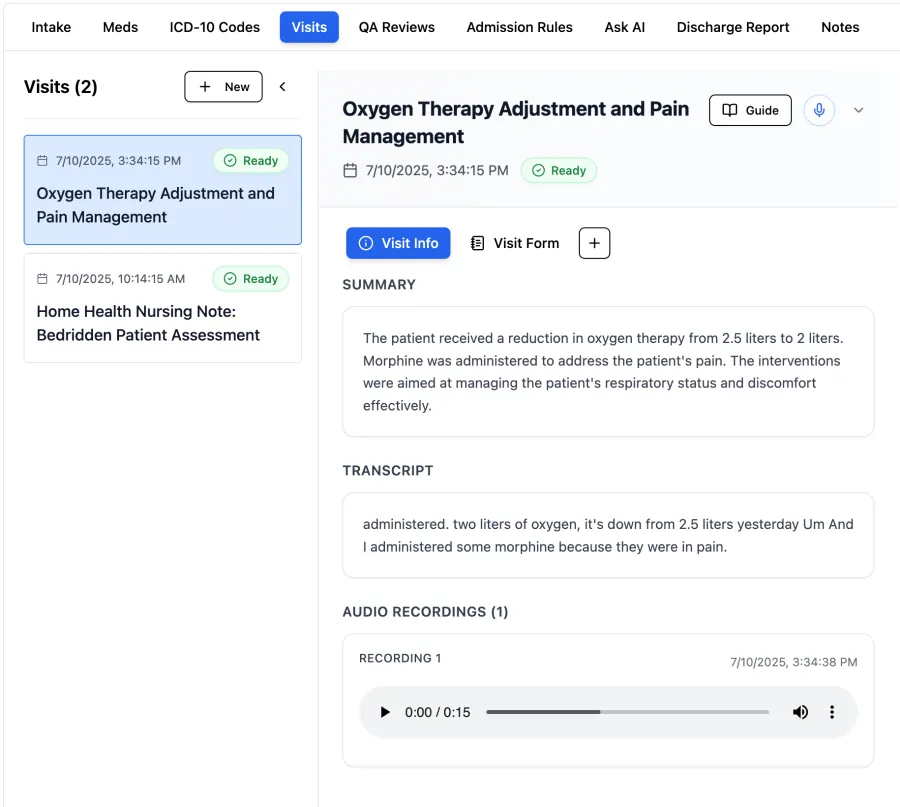
AI clinical notes trusted by clinicians across home health and hospice. Automated clinical documentation that meets the highest standards of clinical accuracy.
Features
Key Features
Real-Time AI Note Generation
Ambient AI captures and structures clinical information during patient encounters, producing complete clinical notes by the time the visit ends.
Clinical-Grade Accuracy
Trained on millions of clinical encounters to ensure accurate medical terminology, proper documentation structure, and comprehensive assessment narratives.
Customizable Note Templates
Configure AI clinical note templates to match your agency's documentation standards and workflows across all disciplines and visit types.
Multi-Discipline Support
AI clinical notes support nursing, therapy (PT/OT/SLP), social work, and aide documentation, each with discipline-specific requirements built in.
Save 2–3 Hours Per Day
Clinicians report saving an average of 2–3 hours per day on documentation with automated AI clinical notes, eliminating after-hours charting entirely.
Improve Clinical Note Quality
AI ensures complete, compliant documentation every time, reducing audit risk and supporting better patient outcomes.
Reduce Clinician Turnover
Eliminate the documentation burden that drives clinician burnout and turnover in post-acute care.
What Are AI Clinical Notes?
AI clinical notes are clinical documentation generated automatically by an AI system that listens to a patient encounter and produces structured, compliant notes (visit narratives, assessment findings, interventions, and patient outcomes) without the clinician needing to type, dictate, or manually structure the note. AI clinical notes are sometimes called "automated clinical notes," "AI-powered clinical documentation," or "ambient clinical notes."
Modern AI clinical notes platforms use ambient voice capture during the visit, generate documentation in real time, and let clinicians review and approve before the note syncs to the EMR. The clinician's role shifts from author to reviewer, eliminating the documentation burden that drives burnout and turnover in post-acute care.
How AI Clinical Notes Work
AI-generated clinical notes follow a three-step process:
- Ambient capture. The clinician opens the AI scribe app on a phone or tablet and starts a session. The AI listens to the natural patient encounter, no dictation, no special phrasing, no workflow changes.
- AI note generation. The AI structures the conversation into compliant clinical documentation following the discipline-specific format: nursing visit notes, therapy notes (PT/OT/SLP), OASIS-E2 assessment items, hospice IDG notes, or social work narratives.
- Clinician review and approve. The clinician reviews the AI-generated note, edits if needed, and approves it for EMR sync. The whole review process takes 2–5 minutes, vs 30–45 minutes of manual charting.
Automated Clinical Notes vs Manual Documentation
The difference between automated clinical notes and manual documentation isn't just speed, it's a fundamental change in the clinician's workflow:
- Time per visit: Manual: 30–45 minutes of charting. Automated: 5–10 minutes of review.
- Completion timing: Manual: documentation completed at home in the evening. Automated: complete by the time the visit ends.
- Consistency: Manual: varies by clinician fatigue, experience, and writing style. Automated: every note follows the same structured format with all required elements.
- Compliance: Manual: relies on clinician recall of every documentation requirement. Automated: AI ensures medical necessity narratives, skilled need justification, and compliance items are always captured.
- Burnout impact: Manual: documentation burden is the #1 driver of clinician burnout and turnover. Automated: clinicians report dramatically improved work-life balance.
Clinical Note Types Supported
Lime Health AI generates clinical notes across all post-acute disciplines and visit types:
- Home health visit notes, skilled nursing visit notes, therapy progress notes, aide visit notes, social work assessments
- OASIS-E2 assessments (SOC, ROC, recertification, transfer, discharge) populated from the natural visit conversation
- Hospice IDG notes, interdisciplinary group documentation, recertification narratives, face-to-face encounter notes
- HOPE assessments, for hospice agencies preparing for the new CMS HOPE tool
- Plan of care updates, generated from clinical findings and patient progress
- Admission notes, drafted automatically during start-of-care visits
Are AI Clinical Notes Accurate?
AI clinical notes from purpose-built clinical platforms achieve 95%+ accuracy on the documentation tasks they're designed for. Lime’s AI clinical notes achieve 95%+ accuracy across structured assessment items (OASIS-E2, HOPE) and narrative sections on first generation.
The clinician always reviews and approves before the note is finalized. AI clinical notes are designed for clinician review, not autonomous documentation, the AI handles the heavy lifting, the clinician applies clinical judgment to verify and refine.
EMR Integration for AI Clinical Notes
Lime Health AI clinical notes integrate natively with the major home health and hospice EMRs: WellSky, MatrixCare, Axxess, DSL (Delta Health), HCHB (Homecare Homebase), and Netsmart. AI-generated notes sync directly to the correct visit record, OASIS assessment fields populate automatically, and ICD-10 code suggestions flow into the coding workflow.
AI Works Best With Trained Operators
Automated clinical notes are powerful, but agencies getting the highest accuracy and the fastest turnaround pair the AI with trained team members operating it. The AI captures and structures documentation; trained reviewers, coders, and QA staff validate, edit, and finalize. The bundle delivers consistent quality at predictable cost. Get the staff and the AI in one engagement: Virtual Staffing. Software is often included at no additional cost.
Related Resources
FAQ
AI Clinical Notes FAQ
Common questions about AI-generated clinical notes for home health and hospice.
AI clinical notes are clinical documentation generated automatically by an AI system that listens to a patient encounter and produces structured, compliant notes (visit narratives, assessment findings, interventions, and patient outcomes) without manual typing or dictation. Modern AI clinical notes use ambient voice capture during the visit, generate the documentation in real time, and let clinicians review and approve before the note syncs to the EMR.
AI clinical notes work in three steps. (1) Capture: an ambient AI scribe listens to the natural patient encounter through a phone or tablet. (2) Generation: the AI structures the conversation into compliant clinical documentation following the discipline-specific format (nursing visit note, therapy note, OASIS assessment items, hospice IDG note). (3) Review: the clinician reviews the AI-generated note for accuracy, edits if needed, and approves it for EMR sync. The whole process takes 5-10 minutes vs 30-45 minutes of manual charting.
AI clinical notes from purpose-built clinical platforms achieve 95%+ accuracy on the documentation tasks they're designed for. Lime’s AI clinical notes achieve 95%+ accuracy across structured assessment items (OASIS-E2, HOPE) and narrative sections. The clinician always reviews and approves before the note is finalized, AI clinical notes are designed for clinician review, not autonomous documentation.
Home health and hospice clinicians using AI clinical notes report saving 2-3 hours per day vs manual documentation. The biggest savings come from eliminating after-hours charting: documentation is complete by the time the visit ends, vs being completed at home in the evening. Over a 5-day work week, that's 10-15 hours per clinician, equivalent to giving each clinician back almost two full work days every week.
Yes. Lime Health AI clinical notes are fully HIPAA compliant. All audio and clinical data is encrypted in transit and at rest, the platform maintains signed BAAs with every customer, and recordings are deleted after note generation. Patient consent is obtained before each recorded encounter through an affirmative action in the app, the AI never listens or records in the background.
Lime Health AI clinical notes integrate natively with the major home health and hospice EMRs: WellSky, MatrixCare, Axxess, DSL (Delta Health), HCHB (Homecare Homebase), and Netsmart. AI-generated notes sync directly to the correct visit record, OASIS assessment fields populate automatically, and ICD-10 code suggestions flow into the coding workflow. No double entry required.
Ready to transform your clinical documentation with AI?
Request a Demo