
AI ICD-10 Coding for Home Health
What AI ICD-10 coding is, how it handles primary diagnosis selection, PDGM grouping, and comorbidities, where it falls short, and how to use it without giving up coding judgment.
The Short Answer
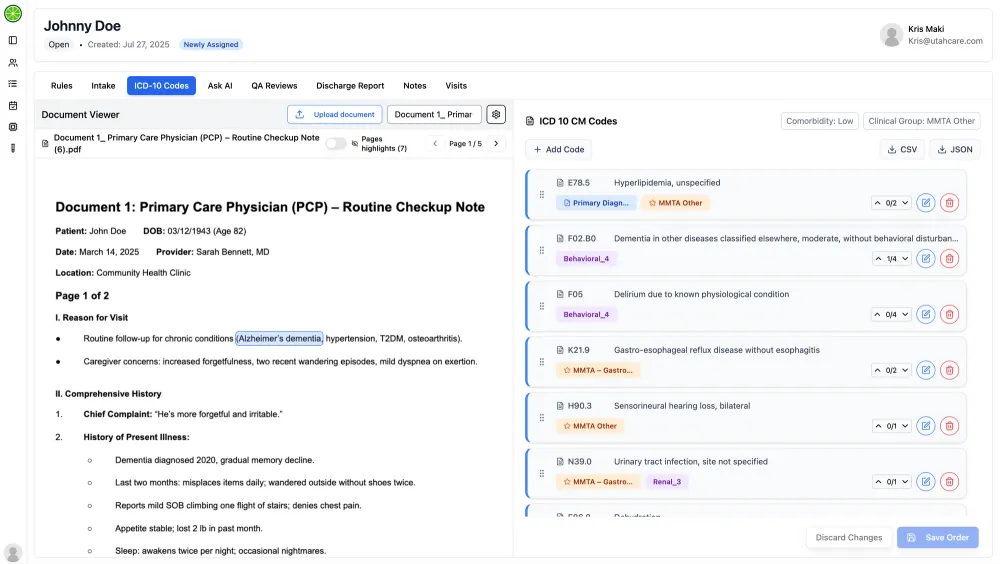
AI ICD-10 coding is software that reads clinical documentation and suggests ICD-10-CM diagnosis codes. In home health, good AI coding proposes a primary diagnosis fitting one of the 12 PDGM clinical groups, captures the secondary diagnoses driving the comorbidity adjustment, codes to the highest specificity the chart supports, and flags codes the documentation does not back up. Your coders review every suggestion and decide. AI speeds up the first draft. It does not replace coding judgment.
What Is AI ICD-10 Coding?
ICD-10-CM is the diagnosis code set every Medicare claim uses. Home health agencies report it in two places: OASIS items M1021 (primary diagnosis) and M1023 (other diagnoses), and the home health claim. The diagnoses on the claim set the PDGM clinical group and the comorbidity adjustment for each 30-day period, so coding errors change payment.
AI ICD-10 coding applies natural language processing to the chart. The software reads free text such as the referral, the hospital discharge summary, physician orders, the OASIS, and visit notes. It finds the conditions documented there, maps each one to a candidate ICD-10-CM code, and proposes a sequence. Better tools also show the sentence in the chart behind each code, so a coder confirms it in seconds instead of searching.
Three terms get mixed up in searches like "ICD-10 AI" and "AI medical coding":
- Code lookup tools search the code set from a typed term. They do not read the chart.
- AI coding suggestion tools read the chart and propose codes for a person to approve. Most home health AI coding sits here.
- Autonomous coding assigns codes and sends them downstream without routine human review. It fits narrow, rules-based coding with little clinical judgment involved.
How AI ICD-10 Coding Works on Home Health Documentation
Home health coding follows rules hospital coding does not. Here is how a home-health-aware AI handles each one.
1. Primary diagnosis selection
The OASIS-E2 Guidance Manual defines the primary diagnosis as the chief reason the patient receives home care and the diagnosis most related to the current plan of care. It is not always the reason for the last hospital stay. A patient discharged after pneumonia who now needs wound care for a surgical incision has a different focus of care than the hospital record suggests.
The AI weighs the referral, the orders, and the skilled services planned, then proposes the diagnosis the plan of care centers on. Per the manual, the assessing clinician determines the diagnoses and a coding specialist may enter the codes. The AI supports both people. It does not make the clinical determination for them.
2. PDGM clinical grouping
Under the Patient-Driven Groupings Model, the primary diagnosis places each 30-day period into one of 12 clinical groups:
| Rehabilitation and other | Medication Management, Teaching, and Assessment (MMTA) |
|---|---|
| Musculoskeletal rehabilitation | MMTA: surgical aftercare |
| Neuro/stroke rehabilitation | MMTA: cardiac and circulatory |
| Wounds | MMTA: endocrine |
| Behavioral health | MMTA: gastrointestinal tract and genitourinary system |
| Complex nursing interventions | MMTA: infectious disease, neoplasms, and blood-forming diseases |
| MMTA: respiratory | |
| MMTA: other |
The clinical group combines with admission source, timing, functional impairment level, and comorbidity adjustment to set one of 432 case-mix groups. A home-health-aware AI shows the clinical group each candidate primary diagnosis produces, so your coder sees the payment effect of a sequencing choice before the claim goes out. Coding has to follow the documentation, never the payment. The grouping view exists to catch errors, not to steer codes. See our PDGM guide for the full model.
3. Comorbidity adjustment
Secondary diagnoses on the claim decide whether a period gets no comorbidity adjustment, a low adjustment, or a high adjustment. A low adjustment applies when a secondary diagnosis falls in one of the comorbidity subgroups CMS lists. A high adjustment applies when two secondary diagnoses fall in subgroups CMS identifies as interacting.
Missed comorbidities lower payment and understate patient complexity. A patient with documented chronic kidney disease, heart failure, and diabetes needs all three coded when they are active and affect care. The OASIS-E2 manual says other diagnoses belong on M1023 when the plan of care addresses them or when they have the potential to affect the patient's response to treatment. The AI scans the full chart for documented conditions and flags any a coder left off.
4. Specificity
The OASIS-E2 manual requires each code at the highest level of specificity. In practice, specificity means:
- Laterality: right, left, or bilateral when the record states it.
- Type and stage: type 1 vs type 2 diabetes, CKD stage, pressure ulcer stage, heart failure type and acuity.
- Combination codes: one code for linked conditions, such as diabetes with a documented complication, when ICD-10-CM provides one.
- Seventh characters: the correct encounter character on injury codes during aftercare.
When the documentation lacks the detail for a specific code, the AI should not guess. It should flag the gap so your coder queries the clinician or the physician. Lime's AI prompts for the missing detail at the point of documentation, which cuts back-and-forth queries later.
5. Sequencing and coding conventions
ICD-10-CM carries "code first" and "use additional code" instructions, and manifestation codes cannot serve as the primary diagnosis. External cause codes (V, W, X, Y) cannot go in M1021. The AI applies these conventions when it proposes a sequence, and your coder confirms the order against the ICD-10-CM Official Guidelines.
6. Return-to-provider and questionable encounter codes
Some ICD-10-CM codes do not map to any PDGM clinical group. Industry shorthand calls them questionable encounter codes. They tend to be vague symptom codes, conditions unlikely to need skilled home health, or conditions too acute for the home setting. A claim with one of these codes as the primary diagnosis is returned to the provider instead of paid, which delays cash.
The fix is never to swap in a code the chart does not support. The fix is better documentation of the actual reason for care. AI flags a non-groupable primary diagnosis at the point of coding, so your coder reviews the record and queries the clinician before the claim is built.
7. Annual code updates
The ICD-10-CM code set updates every October 1. The FY 2027 code set took effect October 1, 2026, for encounters through September 30, 2027. AI coding tools need the current code set and the matching PDGM grouper logic, or they will suggest deleted codes. Ask any vendor when and how it applies each update.
AI Suggestion vs Autonomous Coding vs Human Coders
Agencies choose among three models, and many combine them.
| AI suggestion | Autonomous AI coding | Human coders only | |
|---|---|---|---|
| Who decides the codes | Your coder | The software | Your coder |
| Speed per chart | Faster than manual | Fastest | Slowest |
| Handles home health judgment calls | Yes, through the coder | Poorly | Yes |
| Compliance risk | Low with review | Higher | Depends on staff |
| Scales with volume | Yes | Yes | Only by hiring |
AI suggestion fits most home health agencies. Primary diagnosis selection depends on the focus of care, which takes clinical context a person should confirm. Autonomous coding suits narrow, repetitive coding with little judgment involved. Home health coding rarely fits this description. Human coders alone work at low volume but turn into a backlog as census grows. For a side-by-side of outsourced firms, see our coding and QA services comparison and the home health coding services buyer's guide.
Is AI ICD-10 Coding Accurate? Accuracy and Compliance
Accuracy claims mean little without a definition. Before you trust a number, ask what it measures: exact code match, primary diagnosis match, or PDGM group match. Ask who scored it and on how many charts. Then test the tool on your own charts in a pilot.
Keep these compliance points in view:
- Code to the record. Every code needs support in the documentation. A code added for payment without support creates overpayment and False Claims Act exposure, whether a person or software suggested it.
- Keep a person accountable. HIPAA requires adherence to the ICD-10-CM Official Guidelines. Your agency owns the codes it submits, not the software vendor.
- Keep the evidence trail. Store the chart evidence behind each code. When a MAC, RAC, or UPIC sends an ADR, the trail shows why each code was chosen.
- Match OASIS and claim. Diagnoses on M1021 and M1023 should agree with the claim. Check both before billing.
- Protect PHI. The vendor processes protected health information, so it needs a signed Business Associate Agreement and encryption in storage and in transit.
How Lime Fits
Lime starts at the visit. OASIS Scribe captures the visit conversation and drafts the OASIS and visit note, so the documentation your coders work from is more complete to begin with. Clinicians spend 75% less time on documentation.
- AI-suggested codes: Lime's AI reads the clinical documentation and suggests ICD-10 codes, with the chart evidence behind each one.
- Flags before submission: the AI flags missing or potentially incorrect codes and primary diagnoses PDGM will not group, so your coders fix them first.
- Sequencing support: the AI proposes a sequence, and your coders confirm it.
- Documentation prompts: when the chart lacks detail for a specific code, the AI prompts the clinician while the visit is fresh.
- Your team decides: Lime's AI suggests codes and flags issues. Your coders and QA team make every final decision.
Agencies short on coders add Lime's virtual coding staff. For OASIS consistency checks, see AI OASIS review. For audits of coded claims against documentation, see coding audit. Sentinel QA reviews submitted visit notes and drafts coding for your coders to review. Lime uses per-chart volume pricing, offers pilots, and matches competitor pricing. See pricing.
Related Coding Resources
From a medical coder using Lime
The ability to quickly convert conversations or assessment details into structured documentation helps reduce repetitive typing and improves workflow efficiency.
FAQ
AI ICD-10 Coding, Answered
The questions agencies ask about using AI for home health ICD-10 coding.
AI ICD-10 coding uses software to read clinical documentation and suggest ICD-10-CM diagnosis codes. In home health, the AI reads the referral, the OASIS, and the visit notes, proposes a primary diagnosis and secondary diagnoses, and flags codes the documentation does not support. Your coders review the suggestions and make the final call.
AI handles the first draft well: finding diagnoses in the chart, matching them to ICD-10-CM codes, checking specificity, and flagging primary diagnoses PDGM will not accept. It does not replace coding judgment. Home health coding depends on the focus of care, the plan of care, and the ICD-10-CM Official Guidelines, so a person on your team should approve every code set before it goes on the OASIS or the claim.
Accuracy depends on two things: the quality of the documentation and the review step after the AI. Weak documentation produces weak codes, whether a person or software does the coding. Lime reports 95% accuracy, and its AI shows the chart evidence behind each suggestion so your coders verify it fast. Measure any vendor against your own charts in a pilot before you rely on its numbers.
Pick a tool built for home health. It should know PDGM clinical groups, comorbidity adjustment, OASIS M1021 and M1023 rules, and the codes PDGM returns to provider. It should show the evidence for each code, keep an audit trail, sign a BAA, and leave the final decision with your coders. Coding AI built for hospital or physician billing is not designed around these home health rules.
No. AI suggestion tools remove the manual search and first draft, so each coder gets through more charts. Your coders still confirm the primary diagnosis, sequencing, and specificity, query clinicians when documentation is unclear, and own the final code set. Some agencies add virtual coding staff for volume spikes.
The AI looks for the chief reason the patient receives home care and the diagnosis most related to the plan of care, which is the OASIS-E2 definition for M1021. It then checks whether the code groups into one of the 12 PDGM clinical groups. If the best-supported code would return the claim to the provider, the AI flags it so your coder reviews the documentation and query the clinician if needed.
It depends on the vendor. The software processes protected health information, so the vendor must sign a Business Associate Agreement and protect data in storage and in transit. Lime signs a BAA with every agency and encrypts data at rest and in transit.
Pricing models vary by vendor. Lime uses per-chart volume pricing, so the rate depends on your chart volume. Pilots are available, and Lime matches competitor pricing.
See AI-suggested ICD-10 codes on your own charts.
Request a Demo