Post-Acute Care AI Tools: A Complete Overview
A comprehensive guide to AI tools available for post-acute care, from documentation and coding to predictive analytics and quality assurance.
Lime Health Team
Lime Health AI
AI Is Reshaping Post-Acute Care
Artificial intelligence is transforming how home health and hospice agencies operate. From clinical documentation to predictive analytics, AI tools are addressing the industry’s most persistent challenges, clinician burnout, documentation burden, coding accuracy, and compliance risk.
This overview covers the major categories of AI tools available for post-acute care, what each does, and how they work together.
Updated for 2026: Ambient documentation went mainstream. The EMRs embedded their own scribes, purpose-built platforms added real-time OASIS coaching and AI coding suggestions, and buyers now compare tools on completeness and audit-defensibility. For the current market, see the ambient clinical documentation companies list.
AI Clinical Documentation (Ambient Scribes)
What it is: AI that captures clinical encounters through voice recording and drafts structured clinical documentation, visit notes, assessment data, and care plan updates.
Why it matters for post-acute care: Home health and hospice clinicians spend 30-60 minutes per visit on documentation, often after hours. AI scribes reduce this to minutes of review time, eliminating the after-hours charting that drives burnout and turnover.
Post-acute-specific requirements:
- Must understand OASIS-E assessment items and scoring conventions
- Must support HOPE assessment data capture for hospice
- Must draft homebound status documentation, skilled need narratives, and clinical-OASIS correlation
- Must integrate with home health EMRs (WellSky, HCHB, Axxess, MatrixCare)
Leading solution: Lime Health AI is the only ambient AI scribe purpose-built for post-acute care, covering home health and hospice workflows with native EMR integrations.
General-purpose alternatives: Nuance DAX, DeepScribe, Suki AI, these serve acute/outpatient settings but lack post-acute-specific features. See Best AI Tools for Healthcare Documentation for detailed comparisons.
AI-Powered Coding
What it is: AI that analyzes clinical documentation and suggests appropriate ICD-10 diagnosis codes, identifying comorbidities, verifying sequencing, and mapping codes to clinical evidence.
Why it matters for post-acute care: Under PDGM, diagnosis codes directly determine reimbursement. Missed comorbidities mean missed PDGM adjustments. Unsupported codes create compliance risk. AI coding improves both accuracy and speed.
Post-acute-specific requirements:
- Must understand PDGM clinical grouping rules and comorbidity adjustments
- Must identify diagnoses documented in clinical notes but not yet coded
- Must verify that codes are supported by clinical evidence (audit defensibility)
- Should flag reimbursement opportunities (e.g., comorbidity adjustments)
Leading solution: Lime Health AI ICD-10 coding analyzes clinical documentation and suggests codes with supporting evidence, integrated with the documentation workflow.
How it compares to outsourced coding: See AI vs. Outsourced Coding for a detailed comparison of speed, cost, accuracy, and scalability.
AI Quality Assurance
What it is: AI that reviews clinical documentation and assessments for accuracy, consistency, and compliance, flagging errors before they reach CMS or trigger audits.
Why it matters for post-acute care: OASIS accuracy directly affects reimbursement, quality scores, and audit risk. Manual QA can only review a fraction of charts. AI QA reviews every assessment in real time.
Post-acute-specific requirements:
- Must cross-reference OASIS/HOPE responses against clinical documentation
- Must flag clinical-OASIS disconnects (e.g., notes describing independent ambulation while OASIS scores requiring assistance)
- Must identify functional scoring patterns that deviate from expected distributions
- Must support OASIS-E2 (in effect since April 1, 2026) and HOPE (in effect since October 1, 2025)
Leading solution: Lime Health AI OASIS/HOPE QA provides real-time assessment quality assurance integrated with the documentation workflow.
Predictive Analytics
What it is: Machine learning models that analyze patient data to predict clinical outcomes, hospitalization risk, episode duration, optimal visit utilization, and patient trajectory.
Why it matters for post-acute care: Under PDGM, visit utilization directly affects margin. Predictive models help agencies allocate visits where they will have the most clinical and financial impact, reducing hospitalizations while managing costs.
Post-acute-specific requirements:
- Must incorporate OASIS data, diagnosis information, and historical patterns
- Must predict hospitalization risk with enough lead time for intervention
- Must support visit utilization optimization within PDGM payment periods
- Must integrate with home health EMRs for real-time decision support
Leading solution: Medalogix provides predictive analytics purpose-built for home health, with models trained on post-acute patient populations.
AI-Powered Patient Engagement
What it is: AI tools that support patient communication, remote monitoring, and engagement between visits, extending the care team’s reach without adding visits.
Why it matters for post-acute care: Home health patients are seen periodically, not continuously. Between visits, patients manage their own conditions. AI-powered engagement tools provide education, symptom monitoring, and care plan reinforcement.
Emerging capabilities:
- Automated patient check-ins between visits
- Symptom monitoring with escalation to clinical staff
- Medication adherence reminders and education
- Care plan reinforcement and patient education delivery
Market status: This category is still emerging in post-acute care. Most solutions are adapted from acute care remote monitoring rather than purpose-built for home health or hospice workflows.
How AI Tools Work Together
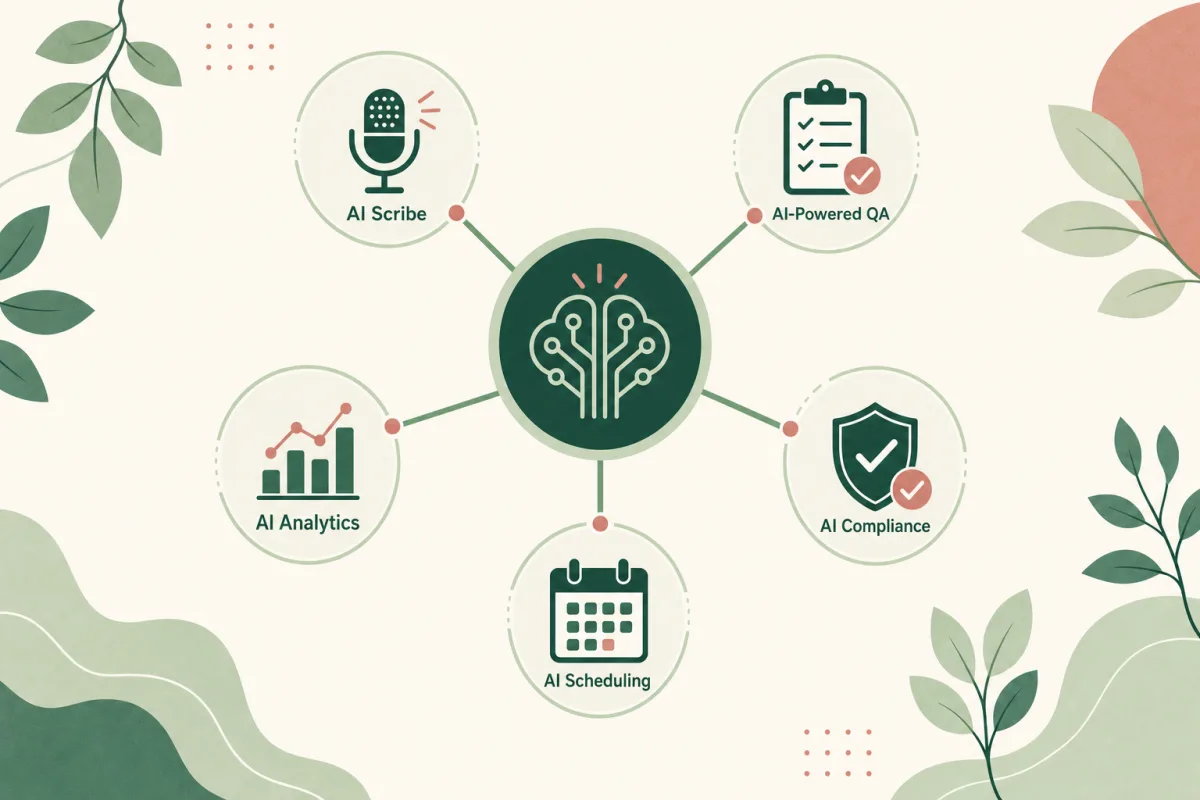
The most effective AI implementations in post-acute care combine multiple capabilities rather than deploying isolated point solutions:
- AI scribe captures the clinical encounter → drafts documentation
- AI coding analyzes the documentation → suggests ICD-10 codes
- AI QA reviews the assessment → flags accuracy issues
- Predictive analytics analyzes patient data → guides visit utilization
- AI engagement extends care between visits → monitors patient status
Platforms that integrate documentation, coding, and QA in a single workflow (like Lime Health AI) reduce the complexity of managing multiple AI vendors while delivering more value than disconnected tools.
AI Tools Resources
- Best AI Scribes for Post-Acute Care, Detailed comparison of ambient AI documentation tools
- Best AI Tools for Healthcare Documentation, Broader healthcare AI comparison
- AI vs. Manual Charting, How AI documentation compares to traditional methods
- AI vs. EMR-Only Workflows, Why supplementing your EMR with AI improves outcomes
- The Future of AI in Healthcare Documentation, Where the technology is heading