OASIS-E2 vs HOPE Assessment: Key Differences in 2026
OASIS-E2 is the home health assessment. HOPE is for hospice. What each does, how they differ, and what agencies serving both populations need to know.
Lime Health Team
Lime Health AI
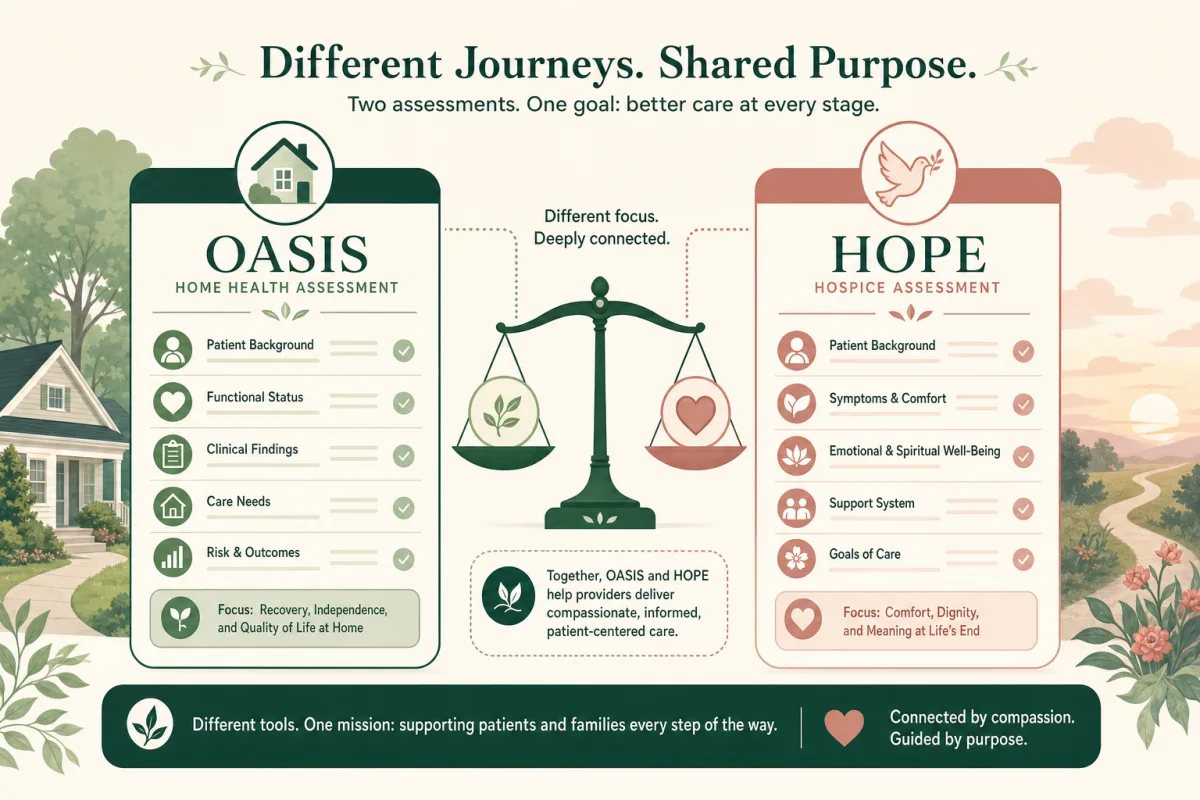
OASIS-E2 vs HOPE: Different Assessments, Different Patient Populations
There’s a lot of confusion about the relationship between OASIS-E2 and the HOPE assessment, especially because both names share the letter “E” and both come from CMS. Here’s the short answer:
- OASIS-E2 is the assessment for home health (the next iteration after OASIS-E and OASIS-E1, effective in 2026 for Medicare-certified home health agencies).
- HOPE (Hospice Outcomes & Patient Evaluation) is the assessment for hospice (replacing the Hospice Item Set / HIS).
They’re not competing standards. They’re complementary CMS assessments serving different patient populations. If your agency provides both home health and hospice services, you need to understand both.
This post breaks down what each assessment does, the key differences, the timeline for each, and what agencies serving both populations should plan for.
What Is OASIS-E2?
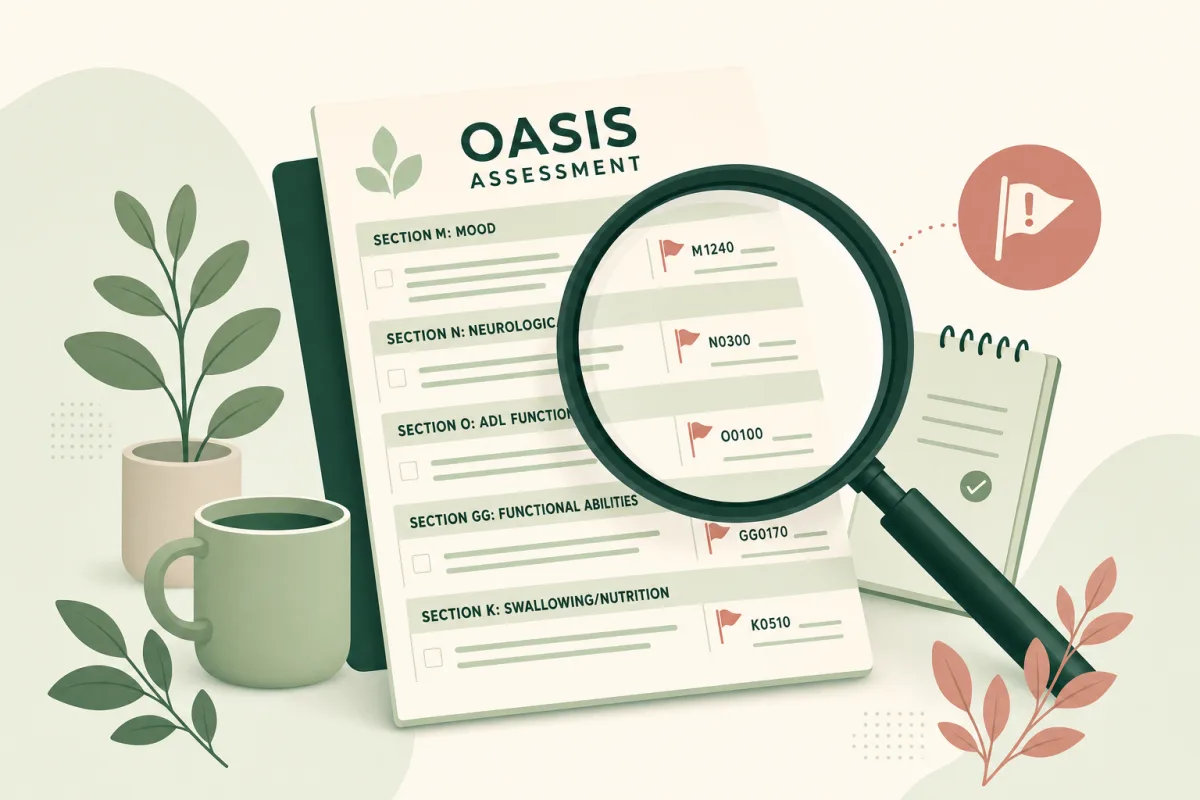
OASIS-E2 is the latest version of the Outcome and Assessment Information Set, used by Medicare-certified home health agencies. It builds on OASIS-E (effective January 1, 2023) and OASIS-E1 (effective January 1, 2025). Key facts:
- Used by: Medicare-certified home health agencies
- Patient population: Adult (non-maternity) patients receiving skilled home health services
- Effective date: 2026 (per CMS)
- Time points: 5, Start of Care, Resumption of Care, Recertification, Transfer, Discharge
- Drives: PDGM payment, Home Health Quality Reporting Program (HH QRP), Star Ratings
- Submission: iQIES system
For the complete OASIS-E2 framework, see the What Is OASIS-E2 hub guide.
What Is HOPE?
HOPE (Hospice Outcomes & Patient Evaluation) is CMS’s hospice patient assessment instrument. Key facts:
- Used by: Medicare-certified hospice providers
- Patient population: Hospice patients
- Effective date: Aligned with the Hospice Quality Reporting Program (HQRP) timeline; replaces the Hospice Item Set (HIS)
- Time points: Multiple time points across the hospice episode (admission, periodic updates, discharge)
- Drives: Hospice Quality Reporting Program, hospice payment under per-diem reimbursement
- Submission: CMS-designated submission system for hospice quality data
HOPE is fundamentally different from OASIS in its design. It’s built around the unique nature of hospice care (symptom management, comfort care, end-of-life goals) rather than functional rehabilitation and skilled care. For more on HOPE, see the HOPE Assessment guide.
The Key Differences
Patient Population
- OASIS-E2: Patients receiving skilled home health for restoration, maintenance, or complex care management. Goal: improve function, manage chronic disease, support recovery.
- HOPE: Patients with terminal illness electing hospice care. Goal: comfort, symptom management, dignity at end of life.
Assessment Focus
- OASIS-E2: Functional assessment (Section GG), cognitive screening (BIMS), behavioral indicators (PHQ), Social Determinants of Health, clinical and service utilization domains.
- HOPE: Symptom assessment (pain, dyspnea, nausea), care preferences, spiritual/emotional needs, family support, hospice-specific outcomes.
Time Points
- OASIS-E2: Five required time points across the home health episode (SOC, ROC, Recertification, Transfer, Discharge).
- HOPE: Multiple time points spanning the hospice care continuum, with admission, periodic, and discharge assessments.
Payment Model
- OASIS-E2 → PDGM: OASIS responses determine clinical group, functional impairment level, and comorbidity adjustment, which together drive 30-day payment under PDGM.
- HOPE → Hospice Per Diem: HOPE feeds quality reporting that affects future payment rates; the per-diem hospice payment structure is more stable but tied to overall quality performance.
Quality Reporting
- OASIS-E2: Home Health Quality Reporting Program (HH QRP) and Star Ratings for home health.
- HOPE: Hospice Quality Reporting Program (HQRP) and the Hospice Care Index.
Side-by-Side Summary
| Dimension | OASIS-E2 | HOPE |
|---|---|---|
| Setting | Home health | Hospice |
| Replaces | OASIS-E1 | Hospice Item Set (HIS) |
| Primary use | Functional + clinical assessment | Symptom + comfort care assessment |
| Payment system | PDGM (30-day periods) | Hospice per diem |
| Quality program | HH QRP / Star Ratings | HQRP / Hospice Care Index |
| Time points | 5 (SOC, ROC, Recert, Transfer, Discharge) | Multiple across hospice episode |
| Submission system | iQIES | CMS-designated hospice submission system |
| Effective date | 2026 (per CMS) | Per CMS HQRP timeline |
What Agencies Serving Both Populations Need to Know
Many post-acute organizations serve both home health and hospice patients, sometimes the same patients transition between services. If that describes your agency:
Train Clinicians on Both Assessments
Clinicians who cross between home health and hospice need separate, distinct training on OASIS-E2 and HOPE. The two assessments use different scoring philosophies, different terminology, and serve different documentation purposes. Don’t assume OASIS competency translates to HOPE competency.
Maintain Two Separate QA Workflows
The QA rules for OASIS-E2 and HOPE are fundamentally different. OASIS QA emphasizes functional consistency, PDGM scoring, and SDOH completeness. HOPE QA emphasizes symptom assessment quality, care preference documentation, and spiritual/emotional dimensions. Plan two separate QA programs, one for each population.
Track Patient Transitions Carefully
When a home health patient elects hospice, the documentation transition is critical. The discharge OASIS for home health and the admission HOPE for hospice should accurately reflect the patient’s status at the same point in time, but they capture different information. Inconsistencies between these can trigger questions from auditors.
Use Tools That Support Both
Your EMR and AI documentation tools should support both OASIS-E2 and HOPE workflows. For ambient AI scribes specifically, this means the tool needs to recognize whether the visit is a home health or hospice encounter and apply the appropriate assessment framework. Lime Health AI supports both, for hospice documentation specifically, see Lime’s hospice scribe.
When Will HOPE Replace HIS?
CMS announced HOPE as the eventual replacement for the Hospice Item Set (HIS). The transition timeline depends on CMS rulemaking and implementation guidance. Hospice providers should:
- Monitor CMS announcements regularly
- Plan training and EMR transition similar to the OASIS-E1 → OASIS-E2 transition
- Don’t wait until effective date to begin preparation, the lessons from OASIS-E2 implementation suggest 90+ days of transition planning is the floor
The Common Thread: AI Reduces the Documentation Burden
Both OASIS-E2 and HOPE require time-intensive documentation. Both have complex scoring rules. Both drive payment and quality reporting consequences. And both can benefit dramatically from ambient AI documentation tools:
- For home health: Lime’s OASIS-E2 ambient scribe cuts documentation time from 30+ minutes to under 10 per visit.
- For hospice: Lime’s hospice scribe captures IDG notes, recertification narratives, and HOPE-aligned assessments from the natural visit conversation.
For agencies serving both populations, a single platform that supports both OASIS-E2 and HOPE workflows simplifies clinician training, reduces tool sprawl, and creates a unified audit trail.
Common Confusion Points
”Is HOPE replacing OASIS?”
No. HOPE is for hospice. OASIS continues to exist (now in OASIS-E2 form) for home health. The two assessments serve different patient populations and won’t be merged.
”Do I need to do both for the same patient?”
Generally no, patients are either receiving home health (OASIS-E2) or hospice (HOPE), not both simultaneously. When a patient transitions from home health to hospice, you complete a discharge OASIS and an admission HOPE.
”Are OASIS-E2 and HOPE submitted to the same place?”
No. OASIS-E2 is submitted via iQIES. HOPE is submitted via the CMS-designated hospice submission system per the HQRP timeline.
”Can I use my OASIS-E2 training for HOPE?”
Limited transfer. Some general assessment principles transfer, but HOPE has its own item set, scoring rules, and CMS guidance manual. Plan dedicated HOPE training for hospice clinicians.
What to Do Next
For home health agencies preparing for OASIS-E2:
- Read the OASIS-E2 hub guide
- Review the OASIS-E2 implementation playbook
- Train clinicians on the OASIS-E2 changes
For hospice agencies preparing for HOPE:
- Monitor CMS announcements for the HOPE effective date
- Review the HOPE Assessment guide
- Plan a 90-day implementation timeline similar to OASIS-E2 rollout
For agencies serving both populations, book a 25-minute call and we’ll walk through how Lime supports OASIS-E2 documentation for home health and HOPE-aligned documentation for hospice in a single platform.