OASIS-E2 in 90 Days: A Home Health Playbook
A week-by-week OASIS-E2 implementation plan that avoids PDGM payment leakage and clinician burnout. Team structure, training, EMR config, and go-live.
Lime Health Team
Lime Health AI
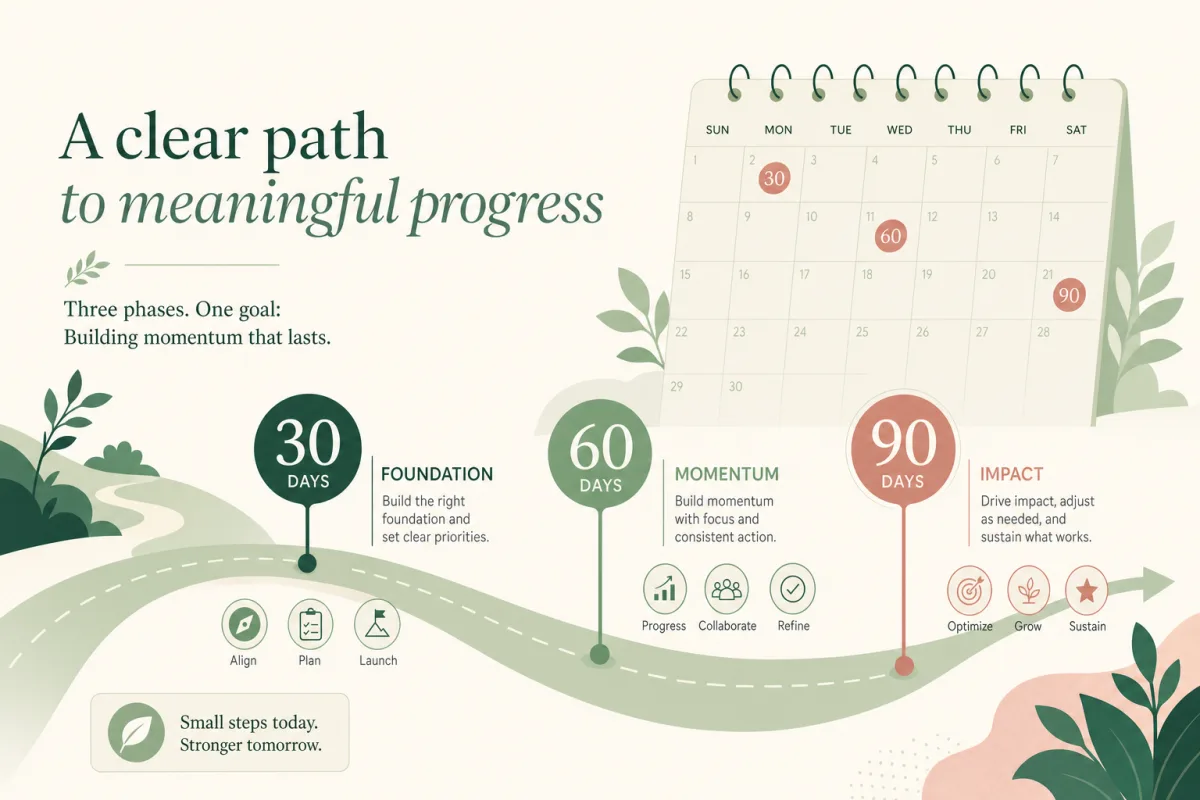
Why 90 Days Beats 30 Days for OASIS-E2 Rollout
OASIS-E2 went into effect in 2026, and many home health agencies are scrambling to roll it out as fast as possible. The temptation is to compress the implementation into a single training day and call it done.
We’ve seen this play out across hundreds of OASIS-E and OASIS-E1 rollouts. Agencies that compress implementation below 60 days consistently see higher error rates, PDGM payment leakage that takes months to recover from, and elevated clinician dissatisfaction. Agencies that follow a structured 90-day plan see the opposite: error rates stay low, payment patterns stabilize within 30 days, and clinicians actually appreciate the new workflow.
This post lays out the 90-day OASIS-E2 implementation playbook, phase by phase, role by role, metric by metric. For the deeper operational detail, see the full OASIS-E2 Implementation Playbook page.
The 5 Phases of OASIS-E2 Implementation
A successful OASIS-E2 implementation runs through five sequential phases over approximately 17 weeks (about 4 months from kickoff to full clinical adoption).
Phase 1: Planning (Weeks 1–2)
Goal: Set up the team, capture baselines, and establish the project charter.
- Form the OASIS-E2 implementation team
- Establish baseline metrics: current OASIS error rates, average PDGM payment per 30-day period, denial rate, time-to-OASIS-completion, after-hours charting volume
- Review the CMS OASIS-E2 Guidance Manual and identify highest-impact item changes for your patient population
- Communicate timeline and expectations to all clinical staff
If you skip baseline measurement, you can’t measure success. This is the most common Phase 1 mistake.
Phase 2: EMR & Policy Configuration (Weeks 3–5)
Goal: Get the technical and policy infrastructure ready before training begins.
- Confirm OASIS-E2 form updates from EMR vendor (HCHB, WellSky, MatrixCare, Axxess, DSL)
- Test new forms in EMR sandbox / test environment
- Update internal QA rules and templates for refined items
- Update written OASIS policies and procedures (referenced in survey)
- Update clinician orientation materials
- Configure reporting dashboards to track OASIS-E2-specific metrics
Most home health EMR vendors push OASIS-E2 form updates automatically. Don’t assume EMR vendor updates equal full implementation, they’re necessary but not sufficient.
Phase 3: Clinician Training (Weeks 5–10)
Goal: Every OASIS-completing clinician understands OASIS-E2 and the changes from OASIS-E1.
A complete training curriculum covers:
- Weeks 5–6: Foundation, OASIS-E2 framework, item-level changes, CMS Guidance Manual review, common error patterns
- Weeks 7–8: Section GG deep dive, scoring methodology, PDGM functional impairment level, case studies, inter-rater reliability checks
- Week 9: SDOH and cognitive/behavioral items, BIMS, PHQ-2/9, sensitive interviewing techniques, role-play
- Week 10: Knowledge testing and case study scoring
Total time investment: 8–16 hours per clinician, spread across the weeks. For the complete curriculum, see the OASIS-E2 Training Plan.
Phase 4: Supervised Go-Live (Weeks 11–13)
Goal: Clinicians complete real OASIS-E2 assessments with QA co-signing and feedback.
- Each clinician completes 5–10 OASIS-E2 assessments with senior clinician or QA reviewer co-signing
- Daily QA huddles to discuss errors and judgment calls
- Video review of ride-alongs (with patient consent)
- QA reviewer provides written feedback on each completed assessment
- PDGM payment monitoring, compare new submissions to baseline weekly
Direct from training to independent practice = high error rates. Always include 2+ weeks of supervised practice.
Phase 5: Full Go-Live and Optimization (Weeks 14–17)
Goal: All clinicians sign off on independent OASIS-E2 practice; ongoing optimization begins.
- Clinicians sign off on independent practice after passing competency validation
- Weekly QA dashboard review continues
- Quarterly internal audits begin
- 30/60/90-day metrics review against baseline
The OASIS-E2 Implementation Team
A typical implementation team includes five roles. For agencies under 50 clinicians, roles can be combined. For agencies over 200 clinicians, add a dedicated project manager.
| Role | Typical Person | Time Commitment |
|---|---|---|
| Executive Sponsor | CCO, CFO, or CEO | Weekly 30-min check-ins |
| Clinical Lead | Director of Clinical Services or QA Director | 10–20 hrs/week |
| Training Lead | Educator or senior clinician | 15–25 hrs/week (Weeks 5–13) |
| EMR / IT Lead | EMR coordinator or IT manager | 10 hrs/week (Weeks 3–8) |
| Clinical Champions | Senior clinicians (1 per office or per 10–15 clinicians) | 5–10 hrs/week |
The 7 Implementation Pitfalls to Avoid
Based on patterns from prior OASIS-E and OASIS-E1 rollouts:
- Compressing the timeline below 60 days. Save time by reducing scope or sequencing offices, not by cutting training.
- Assuming EMR vendor updates = full implementation. EMR forms are necessary but not sufficient. Plan training, QA updates, and policy updates separately.
- Skipping baseline metric capture. If you don’t know your pre-OASIS-E2 PDGM payment, error rate, and time-to-completion, you can’t measure success.
- Underweighting Section GG training. GG is the single biggest payment lever. Allocate 2× the time you’d allocate to other item categories.
- Overlooking SDOH interview technique. Most clinicians have never been trained on sensitive social-determinants interviewing. Include role-play.
- Going live without supervised practice. Direct from training to independent practice = high error rates. Always include 2+ weeks of co-signed assessments.
- No PDGM payment monitoring during the first 90 days. Payment leakage compounds quickly. Review weekly, not monthly.
What Metrics to Track
Track these weekly during implementation and monthly thereafter:
- Clinical: OASIS-E2 error rate per clinician, top error categories, time-to-completion per assessment, inter-rater reliability scores
- Financial: Average PDGM payment per 30-day period (vs baseline), claim denial rate, days in A/R
- Operational: Clinician satisfaction (pulse survey), after-hours charting time, time from visit to OASIS submission
- Compliance: QA flag rate, ADR response success rate, % of charts passing internal audit
Set thresholds for each metric and define what triggers escalation (e.g., if average PDGM payment per 30-day period drops more than 5% from baseline, schedule a focused review).
How AI Accelerates OASIS-E2 Implementation
Agencies that pair structured implementation with OASIS Scribe see significantly faster time-to-competency and lower error rates during the first 90 days:
- Clinicians review pre-populated OASIS responses rather than typing from scratch, accelerating learning by exposure
- Real-time QA flags errors at the point of assessment, every mistake becomes a teaching moment
- PDGM scoring guidance built into the workflow, clinicians see the payment implication of their scoring choices
- Reduced time-to-completion frees up training capacity
- Comprehensive audit trail for survey readiness
Implementing OASIS-E2 without an AI scribe is doable. Implementing it with an AI scribe means the technology absorbs most of the documentation and QA burden, letting your clinicians focus on patient care and your QA team focus on edge cases.
Compliance Side: What CMS and Surveyors Watch
OASIS-E2 changes don’t change Conditions of Participation requirements, but they do raise the bar on documentation quality. State surveyors will be watching for:
- Documentation that supports updated OASIS-E2 responses
- Clinician training records (initial training plus annual recompetency)
- QA workflow that catches OASIS-E2-specific errors before submission
- Updated written policies and procedures
- Audit response procedures
For the full compliance breakdown (including audit triggers and the most common OASIS-E2 errors) see the OASIS-E2 Compliance Guide.
Quick-Reference for Clinicians
For the day-to-day OASIS-E2 workflow, give your clinicians the OASIS-E2 Checklist, pre-visit, in-visit, and post-visit checks that catch most errors before submission.
The Bottom Line
A 90-day OASIS-E2 implementation requires more upfront investment than a single-day rollout, but the return is dramatic:
- Lower error rates from day one
- PDGM payment patterns stabilize within 30 days instead of 90+
- Clinicians retain training instead of forgetting it within a week
- QA team isn’t drowning in fixes
- Survey-ready documentation from the start
If your agency hasn’t started OASIS-E2 implementation yet (or if your rollout is in trouble) the time to act is now. Book a 25-minute call and we’ll walk through your specific implementation plan and how AI can carry most of the load.